Taiwanese Mahjong · 4 tai
Half One Suit (Hun Yi Se) in Taiwanese Mahjong: Tai, Examples and Odds
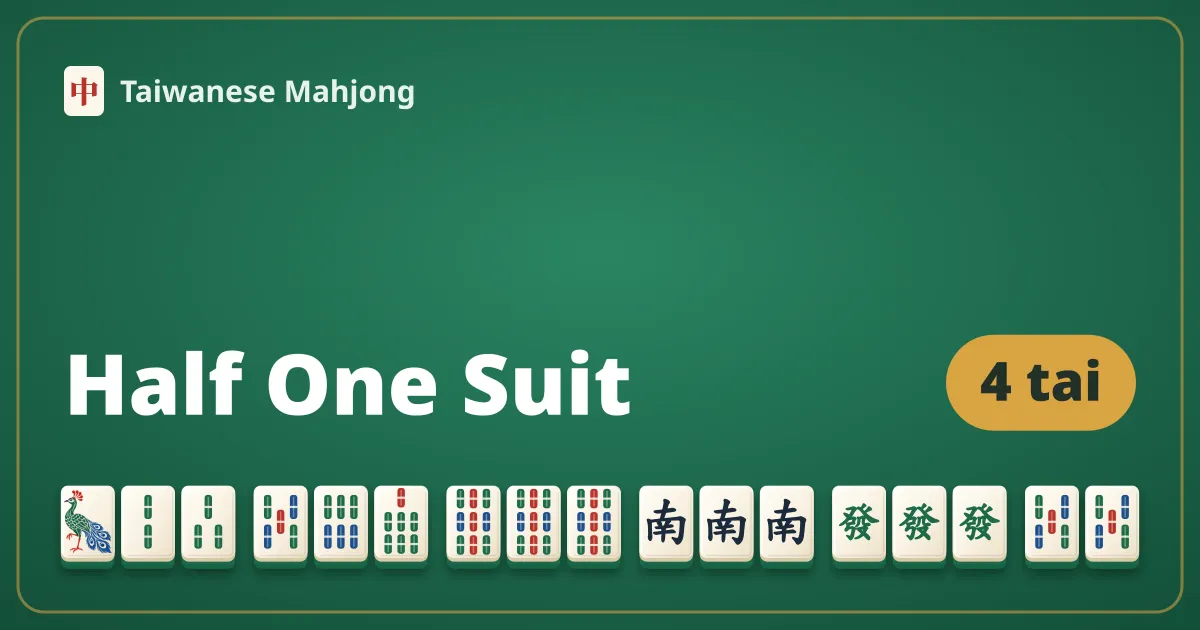
In Taiwanese mahjong, Half One Suit (混一色, hun yi se) is worth 4 tai: when you win, every suited tile in the whole hand — in your hand and in every claimed or kong set — is from one suit (characters, dots or bamboo), and the rest are honor tiles (winds and dragons).
On this page
The rules for Half One Suit
- Suited tiles from one suit only: all characters, all dots or all bamboo
- There must be honors — as pungs or as the pair; with no honors at all it's Pure One Suit
- Chows, pungs and kongs are all allowed — the hand doesn't need to be concealed
- Flowers don't affect it; they score separately as seat flowers or flower sets
Half One Suit vs Pure One Suit vs All Honors
| Hand | Suited tiles | Honors | Tai |
|---|---|---|---|
| Half One Suit | One suit only | Some | 4 |
| Pure One Suit | One suit only | None | 8 |
| All Honors | None | All | 16 |
They are one family and only the highest counts: neither Pure One Suit nor All Honors adds Half One Suit.
How Half One Suit waits
Honors can be punged but never chowed, so in Half One Suit they are almost always pungs or the pair. Two waits are common:
- A suited wait: the honors are already complete and you wait on your suit, e.g. waiting on or . Tiles of one suit connect, so you often wait on several.
- Two pairs, one of them honors: e.g. a pair of and a pair of ; drawing or claiming either wins.
How Half One Suit is scored
The tai below are computed live by the same scoring code the game uses (dealer and dealer-streak tai are added on top).
Won on a discard
| One suit with honors (混一色) | 4 |
| Total | 4 tai |
|---|
Dealer and dealer-streak tai are added on top.
Won on a discard
| Dragon pung (三元牌) | 1 |
| One suit with honors (混一色) | 4 |
| Total | 5 tai |
|---|
Dealer and dealer-streak tai are added on top.
Self-drawn
| Concealed self-draw (不求人) | 3 |
| One suit with honors (混一色) | 4 |
| Total | 7 tai |
|---|
Dealer and dealer-streak tai are added on top.
Common combinations:
| Combination | Tai |
|---|---|
| Half One Suit | 4 |
| Half One Suit + dragon pung | 5 |
| Half One Suit + concealed self-draw | 7 |
| Half One Suit + All Pungs | 8 |
| Half One Suit + Little Three Dragons | 8 |
| Half One Suit + All Pungs + Big Three Dragons | 16 |
How it relates to other hands
- Pure One Suit: replace every honor with tiles of your suit and 4 tai becomes 8. If the honors never come together, switching to Pure One Suit is sometimes the natural move.
- All Pungs: honors can only be punged, so Half One Suit hands are pung-heavy anyway; five pungs add 4 tai.
- Dragon pungs, round wind, seat wind: an honor pung that is a dragon, the round wind or your seat wind scores extra for each set.
- Little Three Dragons, Little Four Winds, Big Three Dragons, Big Four Winds: honor-heavy Half One Suit hands often pick these up on the way, and everything stacks.
Half One Suit odds
How many tiles of one suit plus honors you start with
Half One Suit needs all 17 tiles to be "one suit + honors". A suit has 36 tiles and there are 28 honors, so you have almost twice as many usable tiles as for Pure One Suit, and opening hands are more concentrated. In a 16-tile opening hand, the chance of holding 11 or more tiles of one suit plus honors is about 16%; 12 or more, about 4.9%.
| Most tiles of one suit plus honors in the opening hand | Chance |
|---|---|
| 9+ tiles | 68% |
| 10+ tiles | 39% |
| 11+ tiles | 16% |
| 12+ tiles | 4.9% |
| 13+ tiles | 1.1% |
| 14+ tiles | 0.16% |
Source: 1,000,000 random 16-tile deals (flowers already replaced).
Is forcing Half One Suit worth it?
We had the computer play on this site's table: in each hand the player with the most "one suit + honors" tiles was forced to go for Half One Suit — throw the other suits first, claim only that suit and honors, and never win with anything else — while the other three played normally. Then we compared the average result with the same starts played normally.
| Most tiles of one suit plus honors in the opening hand | Opening hands | Made it | Someone else won | Exhaustive draw | Avg. result forcing it | Avg. result playing normally |
|---|---|---|---|---|---|---|
| 8 or fewer | 59 | 1.7% | 92% | 6.8% | −54 | +2 |
| 9 | 1,648 | 1.2% | 93% | 5.9% | −59 | −3 |
| 10 | 6,694 | 2.4% | 92% | 5.9% | −58 | −0 |
| 11 | 7,032 | 4.4% | 90% | 5.5% | −50 | −2 |
| 12+ tiles | 4,567 | 9.0% | 86% | 5.1% | −29 | +8 |
Source: computer play on this site. In each of 20,000 hands the seat with the best start forced One suit with honors (混一色); the other three played normally. Money at 100 base + 20 per tai, dealer tai included.
Half One Suit is easier than Pure One Suit, but at a fast table forcing it still loses.
- Forcing it from 12 or more tiles of one suit plus honors makes it about 9.0% of the time, for an average result of −29; the same starts played normally average +8.
- The more concentrated the start, the better: 13 or more makes it about 12% of the time, but in 83% of hands someone else wins first.
- When it works the hand averages 6.5 tai, on draw 9.1 — good tai, just not often enough.
- Playing normally, the computer wins with Half One Suit in only 0.08% of its wins: a play-for-speed style rarely ends up there by accident.
When to go for Half One Suit
- Many tiles of one suit plus honors to start: see the numbers above.
- Honor pairs or pungs: pung an honor pair as soon as it's discarded; single honors have to be drawn yourself, which is slow.
- Honors that score on their own: dragon, round-wind and seat-wind pungs add tai, so one or two of them plus Half One Suit add up fast.
- Others will read it: no tiles of your suit in your discards plus a claimed honor pung tells everyone, and they will hold that suit.
When to give up: past the halfway point of the wall you still hold three or more tiles from other suits, or someone else is ready while you are two or more tiles away. To practise the call, open a table of online Taiwanese mahjong — the computer plays with you and scores every hand.
Half One Suit in other mahjong styles
"One suit plus honors" is a standard hand wherever honor tiles exist:
- Japanese mahjong calls it honitsu (混一色): 3 han concealed, 2 han open (Japanese mahjong yaku list)
- Hong Kong mahjong: 3 fan (Hong Kong mahjong fan table)
- Guobiao (Chinese Official) mahjong: 6 fan (Guobiao mahjong fan list)
- Sichuan mahjong has no honor tiles, so it has no Half One Suit
FAQ
How many tai is Half One Suit?
Half One Suit is worth 4 tai in Taiwanese mahjong. It stacks with All Pungs, dragon pungs, round and seat wind, concealed hand, concealed self-draw and more.
Does Half One Suit need honor tiles?
Yes. One suit with no honors at all is Pure One Suit, 8 tai, which never adds Half One Suit as well.
Can I chow or pung in Half One Suit?
Yes. Taiwanese Half One Suit doesn't require a concealed hand; claimed sets just have to be from your suit or honors.
How many tai is Half One Suit with All Pungs?
Half One Suit 4 plus All Pungs 4 is 8 tai; dragon, round-wind or seat-wind pungs add more on top.
Is it Half One Suit if the only honors are the pair?
Yes. Honors as pungs or as the pair both count: one suit plus any honors is Half One Suit.
Related hands
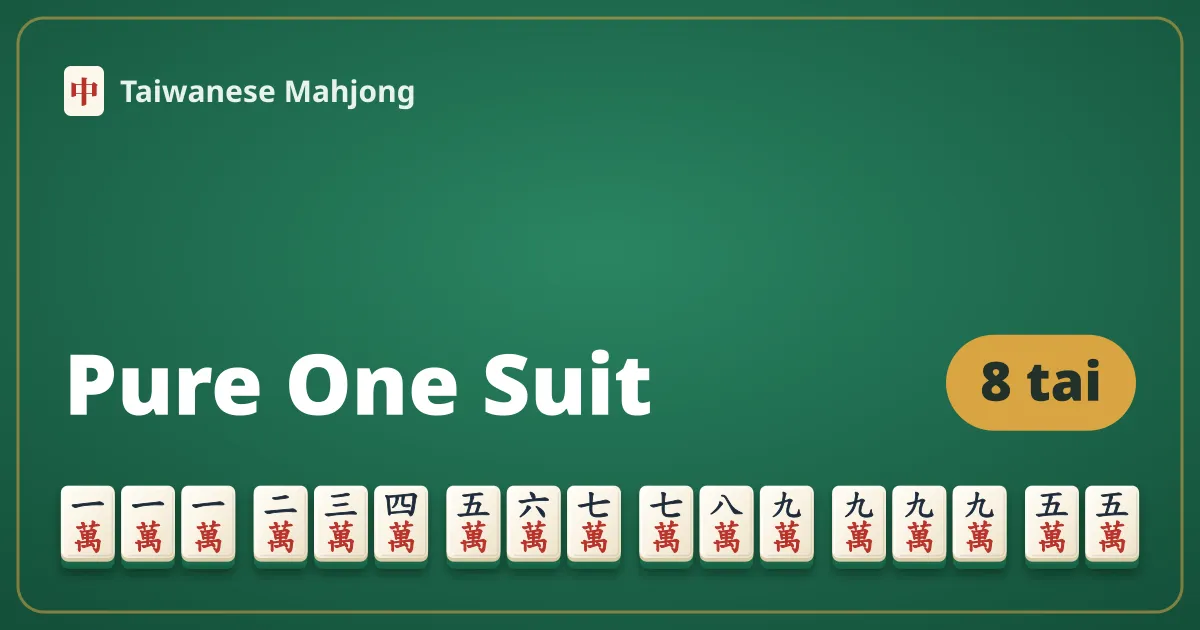 Pure One Suit 8 tai
Every tile from a single suit — an 8-tai big hand. Examples, Half One Suit vs Pure One Suit, and how many suited tiles you need to go for it.
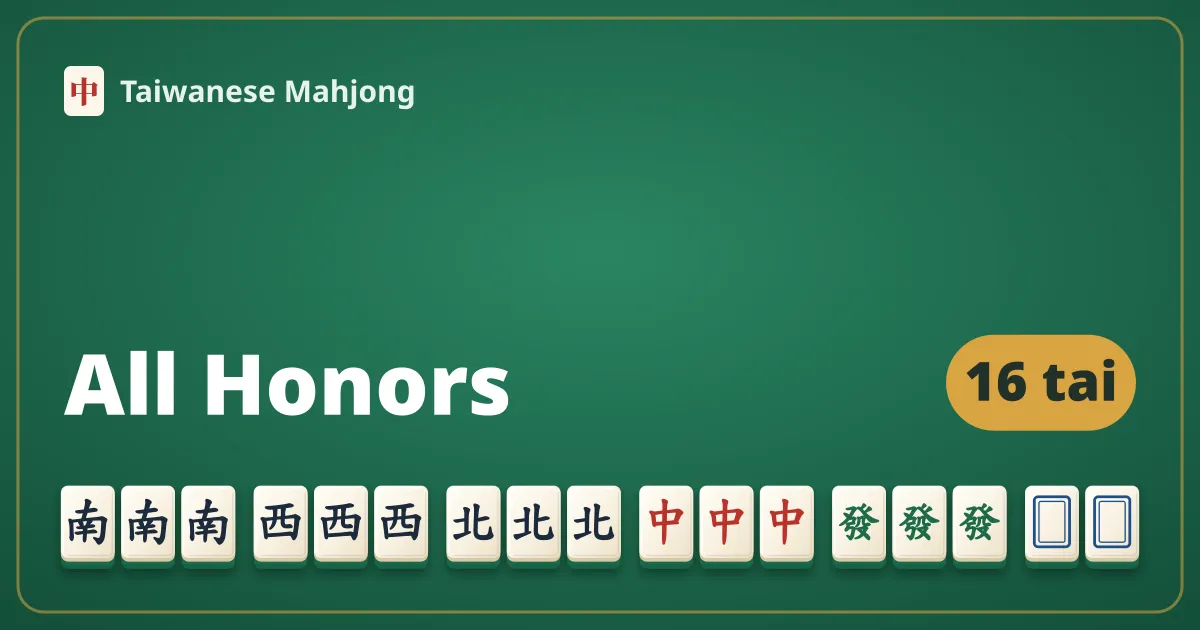 All Honors 16 tai
A hand made only of honor tiles, 16 tai: it always brings dragons or four winds along, so it starts at 20 tai.
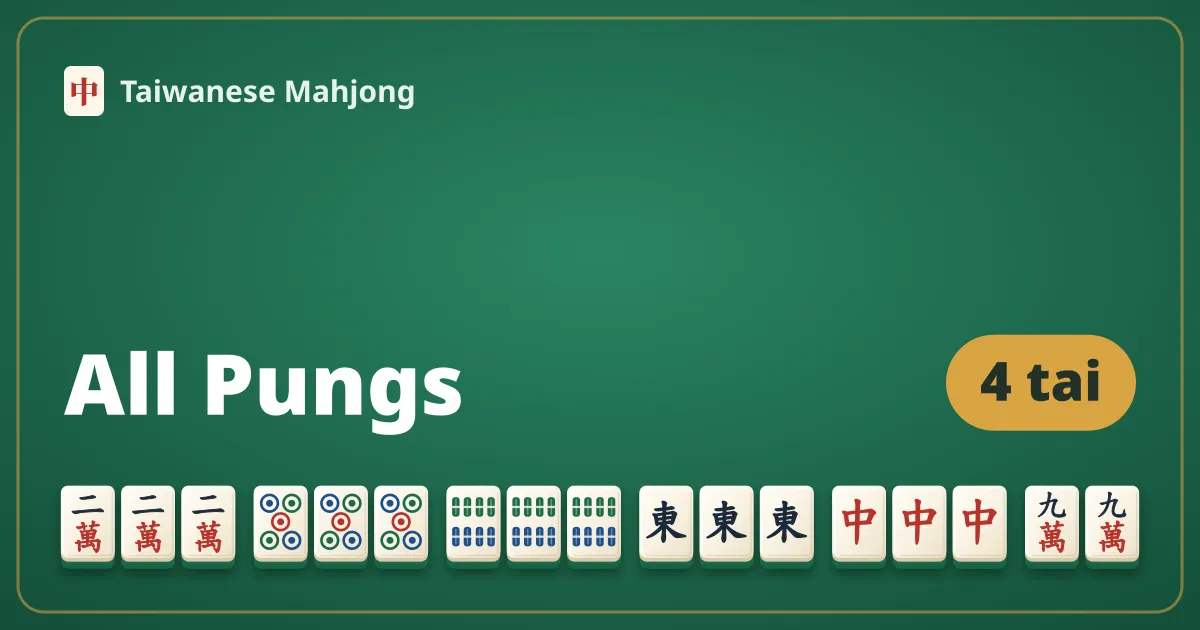 All Pungs 4 tai
Five pungs and a pair, no chows allowed — 4 tai. Examples, scoring combos and how many pairs you need to go for it.
Try it at the table
Taiwanese Mahjong — Play authentic Taiwanese 16-tile mahjong free in your browser against three computer opponents. Flowers, chow, pung, kong, dealer streaks and automatic tai scoring. No sign-up, works on phone and desktop.