Taiwanese Mahjong · How to Play
How to Play Taiwanese Mahjong: Free Online Beginner's Guide

Taiwanese mahjong is a four-player, 16-tile mahjong: everyone holds 16 tiles, takes turns drawing one and discarding one, and the first to complete five sets plus a pair wins, then collects money based on the hand's tai (scoring points). This page walks through a real table in order — the tiles, the dice, dealing, flowers, all the way to winning and scoring — and every rule matches this site's free Taiwanese mahjong game exactly, so you can sit down and practise right after reading.
On this page
- What Taiwanese mahjong is and what you need
- The tiles: 144 tiles in five groups
- Seats, the dealer and the deal
- Flowers: lay them out and replace them
- Your turn: draw one, discard one
- Chow, pung and kong: claiming discards
- Waiting and winning: five sets plus a pair
- Counting tai and paying
- Rules special to Taiwanese mahjong
- Seven tips for beginners
- Play now
- FAQ
What Taiwanese mahjong is and what you need
Taiwanese mahjong is also called "16-tile mahjong". The big difference from Cantonese or Japanese mahjong is three extra tiles in hand: most mahjong uses 13 tiles and four sets plus a pair, while Taiwanese mahjong uses 16 tiles and five sets plus a pair, so hands run longer and there are more ways to build them.
At a real table you need:
- A 144-tile set (including the eight flower tiles)
- Three dice (to choose the dealer and where to break the wall)
- Four players, and an agreed "base" and "per tai" stake
Online it is much simpler: open Taiwanese mahjong online and the game shuffles, deals, replaces flowers and counts tai for you, with three computer opponents — no need to gather four people, no sign-up.
The tiles: 144 tiles in five groups
| Group | Tiles | Count |
|---|---|---|
| Characters (萬) | 1 to 9, four of each, 36 tiles | |
| Dots (筒) | 1 to 9, four of each, 36 tiles | |
| Bamboo (條) | 1 to 9, four of each, 36 tiles | |
| Honors | East, South, West, North (winds) and Red, Green, White (dragons), four of each, 28 tiles | |
| Flowers | Spring, Summer, Autumn, Winter and Plum, Orchid, Bamboo, Chrysanthemum, one of each, 8 tiles |
Characters, dots and bamboo are the "suits" and can form runs; honors can only form pungs or pairs. Flowers are never part of a set: when you get one you lay it out and draw a replacement (see "Flowers" below), but the flowers you lay out can add tai.
The 1 of bamboo is usually drawn as a bird — it is not a flower. The numbers 1–4 printed on the flowers match the seats: Spring and Plum are East, Summer and Orchid South, Autumn and Bamboo West, Winter and Chrysanthemum North.
Seats, the dealer and the deal
- Choosing the dealer: for the first hand one player throws three dice and counts that many seats in turn order, starting with themself; that player becomes the dealer (East). In every later hand, the dealer throws the dice to decide where the wall is broken.
- Seat winds: the dealer's seat wind is East, followed by South, West and North. Play goes counter-clockwise: after your turn comes the player on your right (your "next player"); the player on your left is the one who plays just before you.
- Dealing: starting from the break, each player takes four tiles at a time for four rounds, 16 tiles each; then the dealer takes one more, so the dealer has 17 tiles and everyone else 16, and the dealer discards first.
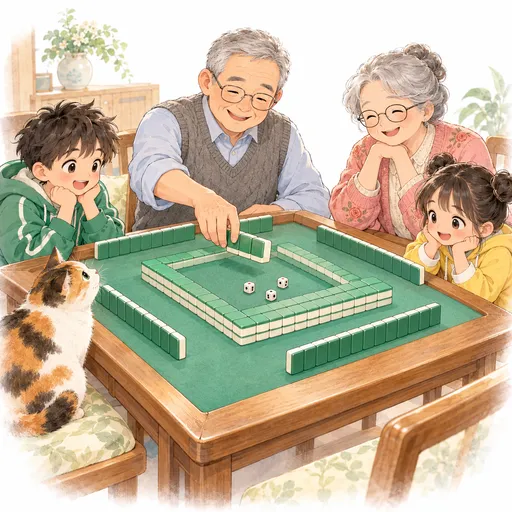
Flowers: lay them out and replace them
You never keep a flower in your hand. After the deal, starting with the dealer, each player lays all their flowers face up and draws the same number of replacements from the back end of the wall; a replacement that is another flower is replaced again, until nobody holds a flower.
Drawing a flower during play works the same way: lay it out at once, draw a replacement from the back of the wall, then carry on with your turn. In this site's game flower replacement is automatic — you just see the flower fly to your side.
Flowers you lay out can score:
- A flower that matches your seat wind is an own seat flower, 1 tai each (for East: Spring and Plum)
- All four of Spring–Winter or of Plum–Chrysanthemum is a flower set, 2 tai per set
- One player collecting all eight flowers is eight flowers, an instant win worth 8 tai

Your turn: draw one, discard one
On your turn:
- Draw a tile from the wall — you now hold 17.
- If that tile completes your hand, you can declare a self-drawn win.
- Otherwise pick a tile you don't need and discard it face up in the middle of the table, back to 16 tiles.
- Play passes to the next player.
Keep your discards in neat rows where everyone can see them: which tiles have already gone is the key clue to what others are waiting for and which tiles are safe.
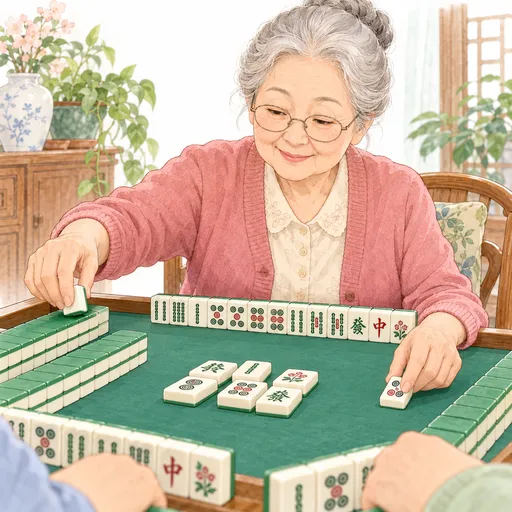
Chow, pung and kong: claiming discards
When someone discards, you may claim the tile to complete a set and lay it face up in front of you:
| Claim | When | Example |
|---|---|---|
| Chow | Completes a run; only from the player on your left (who plays just before you); honors can't be chowed | You hold ; the player on your left discards or |
| Pung | You hold a pair; anyone discards the third | You hold ; someone discards |
| Exposed kong | You hold three of a kind; anyone discards the fourth | You hold ; someone discards |
| Concealed kong | You draw the fourth yourself and declare it on your turn | You hold |
| Added kong | You already punged it and draw the fourth | You punged and draw |
After a chow or pung you don't draw — you discard straight away; after a kong you draw a replacement from the back of the wall and then discard (so a self-drawn win on that tile is win after a kong).
If several players want the same tile: win > pung or kong > chow. For example, the player on your left discards, you want to chow and the player opposite wants to pung — the pung goes first; anyone who can win beats both. If two players can win on the same discard, this site by default lets only the one closest after the discarder win (head bump); the settings let you switch to "multiple winners".
Waiting and winning: five sets plus a pair
A winning hand is five sets + one pair, 17 tiles in total:
- A set is a run (three in a row in one suit, such as ) or a pung (three of a kind, such as ); a kong counts as one set
- The pair is two identical tiles, such as
- Sets you exposed by chow, pung or kong count toward the five
A hand that needs just one more tile is ready (waiting, 聽牌). The 16 tiles below are ready: four sets and a pair are done, and is waiting on or :
Common waits:
- Open (two-sided): waits on and — two tiles can win, the best wait
- Edge: only waits on
- Closed (middle): only waits on
- Pair wait: all five sets done, waiting for one tile to make the pair
- Double pung: two pairs, whichever becomes a pung first
Edge, closed and pair waits only accept one tile and add single wait 1 tai when they win — but the fewer tiles you wait on, the harder it is to win. Turn on the waiting hint in the game and it tells you which tiles you are waiting on and how many are left.
There are two ways to win: drawing the tile yourself is a self-draw; winning on someone's discard is a discard win, and the player who threw it "dealt in".

Counting tai and paying
After a win you add up every scoring pattern the hand meets — that total is the hand's tai. The most common:
| Pattern | Tai | Condition |
|---|---|---|
| Self-drawn | 1 | You drew the winning tile |
| Concealed hand | 1 | No chow, pung or exposed kong; win on a discard |
| Concealed self-draw | 3 | Concealed and self-drawn (replaces concealed + self-drawn) |
| Dragon pung | 1 | A pung of Red, Green or White, per pung |
| Ping hu | 2 | Five runs, no honors or flowers, open wait, win on a discard |
| All pungs | 4 | All five sets are pungs |
| Half one suit | 4 | One suit plus honors |
| Pure one suit | 8 | Only one suit, no honors |
For all 32 patterns and their tai, see the Taiwanese mahjong tai table.
Scoring the ready hand above: say you are the dealer (East), you replaced one Spring (East's own flower), and you then draw the 8 bamboo yourself:
Self-drawn
| Concealed self-draw (不求人) | 3 |
| Dragon pung (三元牌) | 1 |
| Own seat flower (正花) ×1 | 1 |
| Total | 5 tai |
|---|
Dealer and dealer-streak tai are added on top.
Each payment is "base + tai × per tai"; the game's default is base 100 and 20 per tai:
- Self-draw: all three other players pay. Discard win: only the discarder pays; the other two pay nothing.
- Dealer tai: any payment that involves the dealer (the dealer wins, or the dealer pays) gets an extra 1 tai for the dealer, plus 2 more for each consecutive hand the dealer keeps: 3 tai after one repeat, 5 after two — the "N repeats, N more" rule (連 N 拉 N).
- In the example the dealer self-draws with no repeats yet: 5 tai plus 1 dealer tai, so each of the three others pays 220.
Passing the deal: if the dealer wins or the hand is drawn, the dealer stays (a dealer repeat, 連莊); if anyone else wins, the deal passes to the next player. Once every player has dealt, a round (wind) is over; playing all four rounds — East, South, West, North — is a full game. In the game you can choose a quick single hand, an East round or a full four-round game.
Rules special to Taiwanese mahjong
- Reserved wall: the last 16 tiles of the wall (8 stacks) are never drawn. If nobody has won when only those remain, the hand is a draw: the dealer stays and nobody pays.
- Last tile: winning by drawing the last drawable tile is last tile draw, and winning on the last discard is last discard win, 1 tai each. The very last discard can only be won on — no chow, pung or kong.
- Robbing a kong: when someone makes an added kong with the very tile you are waiting on, you can win by robbing the kong; concealed kongs can't be robbed.
- Passed win (過水): if you decline to win on a discard, you can't win on anyone's discard again until your next draw (you can still self-draw).
- No minimum tai: this site has no minimum — even a 0-tai "chicken hand" can win — and no cap. Some tables require a minimum number of tai or score the heavenly and human hands differently, so agree on house rules first.
- Heavenly, earthly and human hands: the dealer winning on the starting 17 tiles is a heavenly hand, 24 tai; a non-dealer self-drawing on their first draw is an earthly hand, 16 tai, and winning on the dealer's very first discard is a human hand, 16 tai (with no claims before it).
Seven tips for beginners
- Win first, win big later. There is no minimum tai, so a small win beats chasing a big hand while someone else wins.
- Throw lone honors early. Unpaired winds and dragons are the hardest tiles to use, so discard them first — but your own seat wind, the round wind and dragons score, so keep those a little longer.
- Keep open waits, break edges. waits on two tiles, on only one; when you must break something, break edge and closed shapes first.
- Don't claim everything. Claiming speeds you up but loses the concealed bonus and shows others your plan; when you are still far from ready, it often isn't worth it.
- Don't feed the next player. Only the player on your right can chow your discards — watch what they chow and expose, and don't hand them what they need.
- Play safe when someone is close. Only the discarder pays, so defence is valuable: tiles that were just discarded and honors with three already showing are the safest.
- Practise with the hints on. The game's waiting hint shows which tiles you are waiting on and how many remain, and the discard hint marks tiles that would make you ready; turn them off once you are comfortable.

Play now
Don't worry about memorising everything — you learn fastest by playing. This site's Taiwanese mahjong online is free, with no download and no sign-up: open your browser and play three computer opponents at beginner, normal or expert level. They only see the public tiles and never peek at your hand, and every win lists each tai, the dealer tai and every payment.
To start right away, go to the game lobby and pick a quick hand; to learn the scoring patterns, start with the ones people ask about most: pure one suit, all pungs and ping hu.
FAQ
Why does Taiwanese mahjong use 16 tiles?
Each player holds 16 tiles and must make five sets plus a pair — one set more than 13-tile mahjong — so there are more hand patterns and each hand lasts longer. The dealer starts with one extra tile, 17 in all, and discards first.
Why can I only chow from the player on my left?
That is the Taiwanese rule: a run can only be claimed from the player on your left, who plays just before you. Pungs and kongs can be claimed from anyone. If one player wants to pung and another to chow the same tile, the pung wins.
What is the minimum tai to win?
There is no minimum on this site: even a 0-tai hand can win, and there is no cap. Some tables agree on a minimum, so settle it before playing with friends.
How do self-draw and discard wins pay differently?
On a self-draw all three other players pay; on a discard win only the discarder pays. Each payment is base + tai × per tai, by default base 100 and 20 per tai.
How are dealer and dealer-repeat tai counted?
Any payment the dealer is part of (winning or paying) adds 1 dealer tai, plus 2 more per consecutive dealer hand: 3 after one repeat, 5 after two. Payments between non-dealers get nothing extra.
When is a hand drawn?
The last 16 tiles of the wall (8 stacks) are never drawn; if nobody has won when only those remain, the hand is a draw. Nobody pays and the dealer stays.
What do I do when I draw a flower?
You can't keep it: lay it out at once and draw a replacement from the back of the wall. A flower that matches your seat wind scores 1 tai each; a full set of four is a flower set worth 2 tai.
How is Taiwanese mahjong different from Cantonese or Japanese mahjong?
Taiwanese mahjong uses 16 tiles, five sets plus a pair and eight flowers, pays by tai, allows chows only from the player on your left, and adds dealer tai and dealer repeats. Cantonese and Japanese mahjong both use 13 tiles and four sets plus a pair, with completely different scoring.
Popular hands
The hands people ask “how many tai?” about most: how to build them, how they score, and how often they show up.
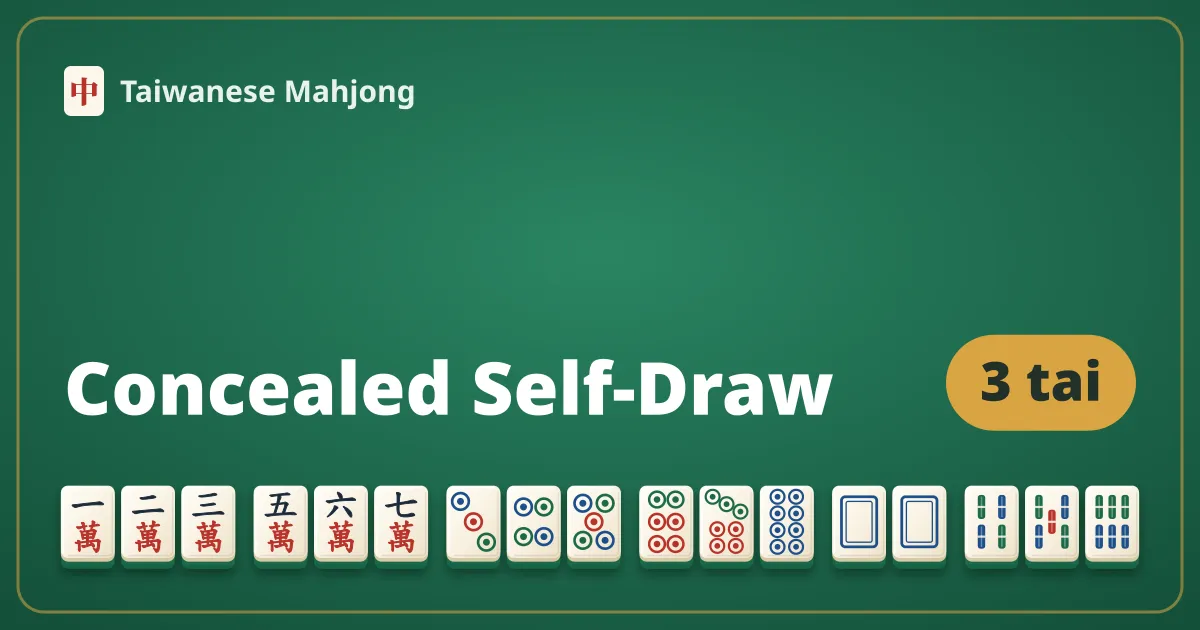 Concealed Self-Draw 3 tai
Never claim a tile and self-draw the win — 3 tai. Concealed hand vs self-draw, concealed kongs and replacement wins, and how often it happens.
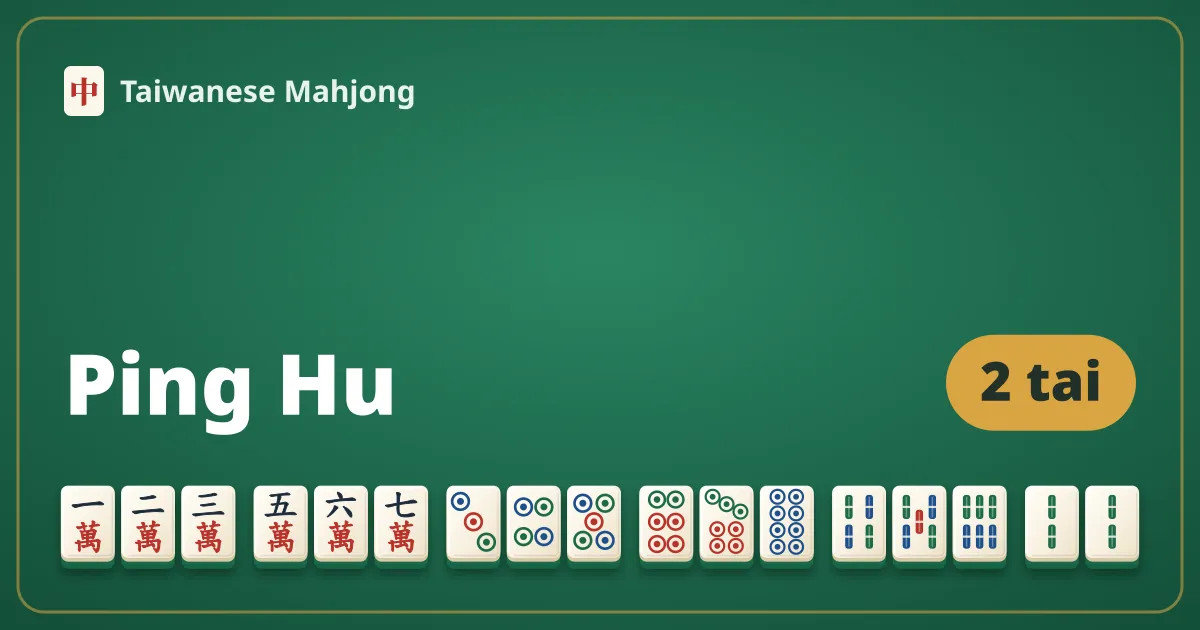 Ping Hu 2 tai
Five chows, no honors, no flowers, two-sided wait, no self-draw — a 2-tai hand. Checklist, common mistakes and odds.
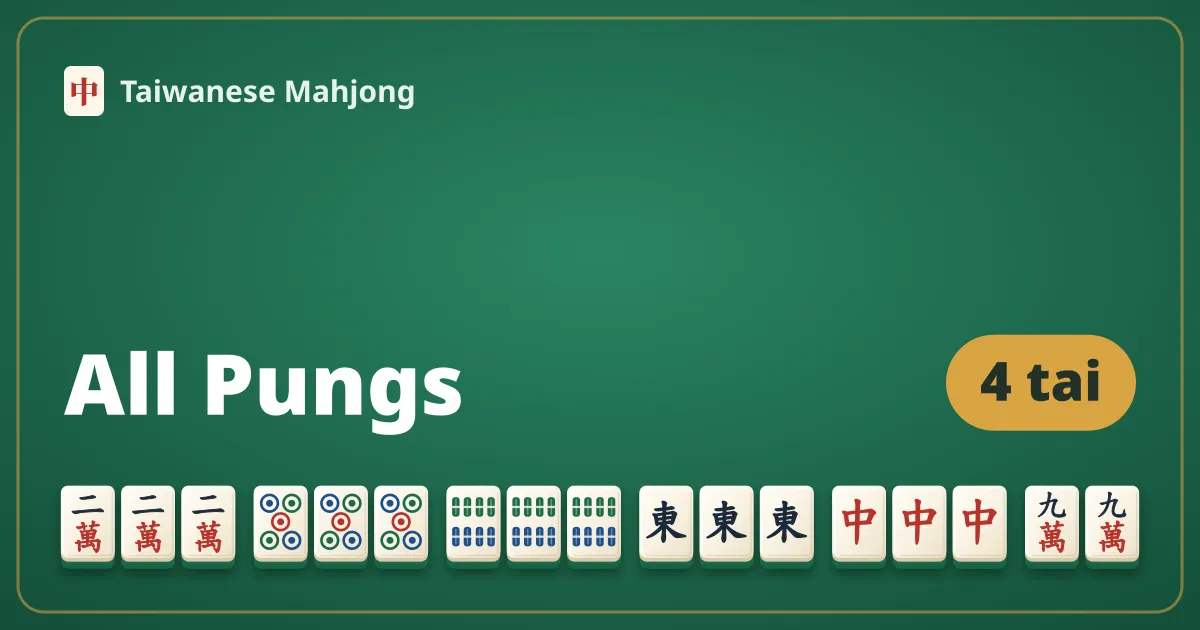 All Pungs 4 tai
Five pungs and a pair, no chows allowed — 4 tai. Examples, scoring combos and how many pairs you need to go for it.
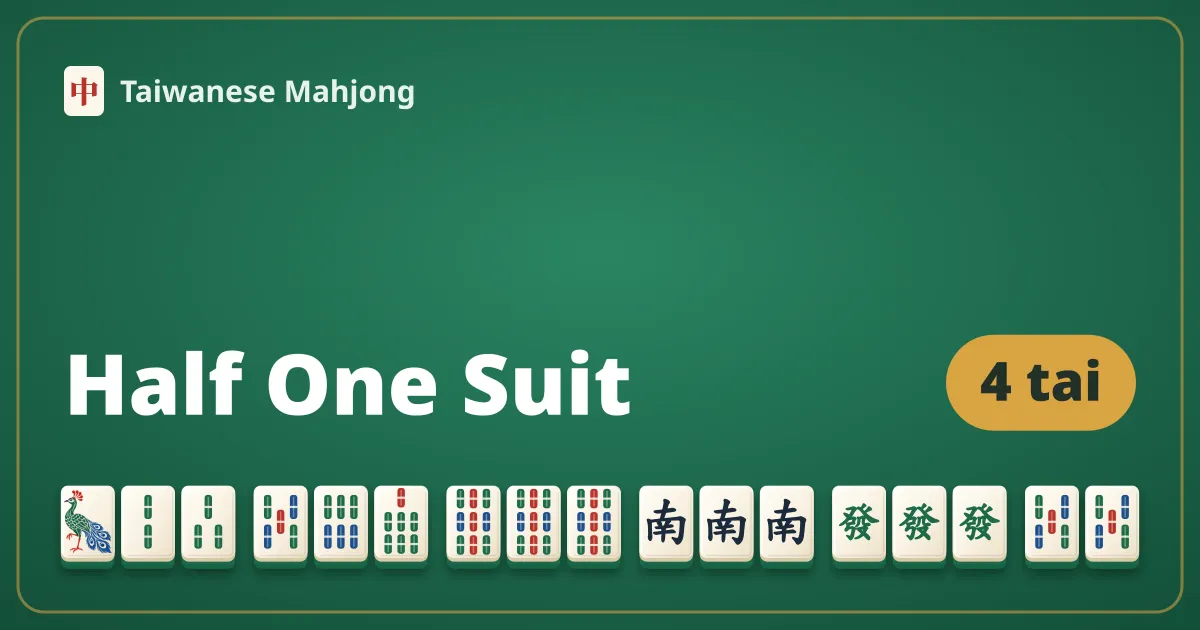 Half One Suit 4 tai
One suit plus honors — a 4-tai hand. Examples, Half One Suit vs Pure One Suit, and how concentrated your start must be.
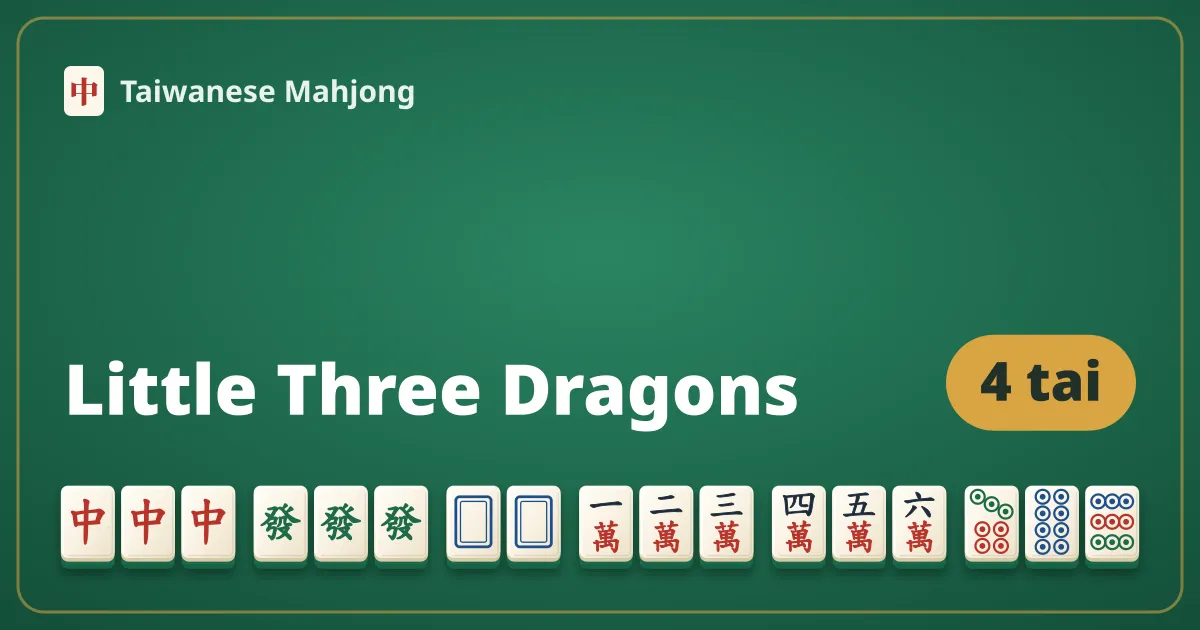 Little Three Dragons 4 tai
Two dragon pungs with the third dragon as the pair — 4 tai. Examples, the two-pair wait, and how it differs from Big Three Dragons.
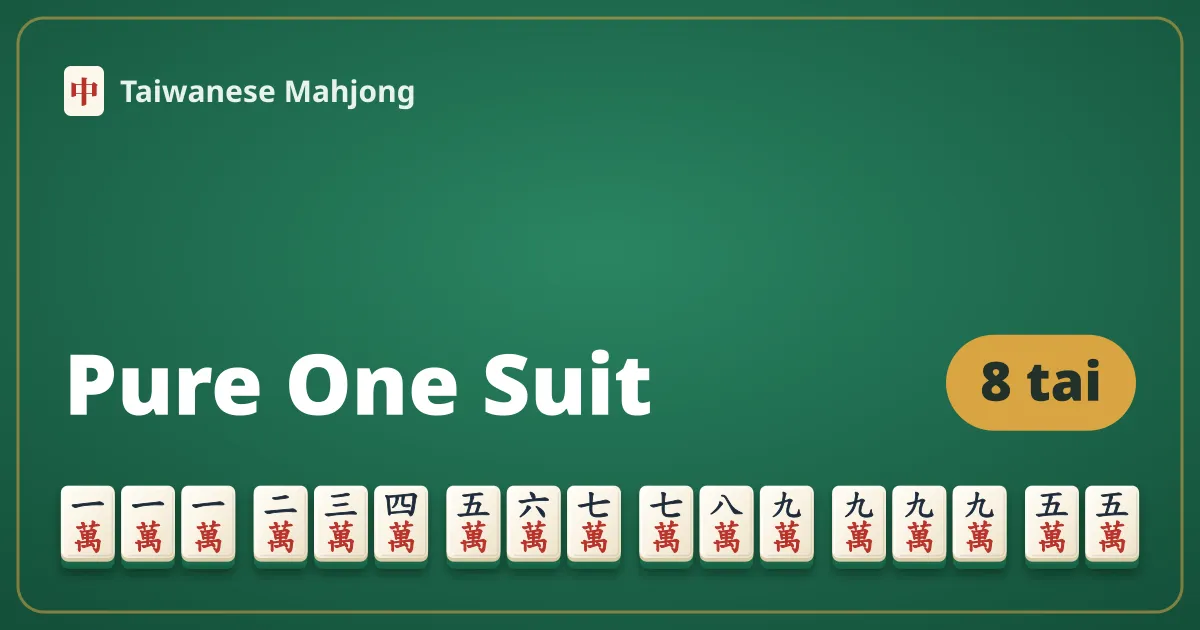 Pure One Suit 8 tai
Every tile from a single suit — an 8-tai big hand. Examples, Half One Suit vs Pure One Suit, and how many suited tiles you need to go for it.
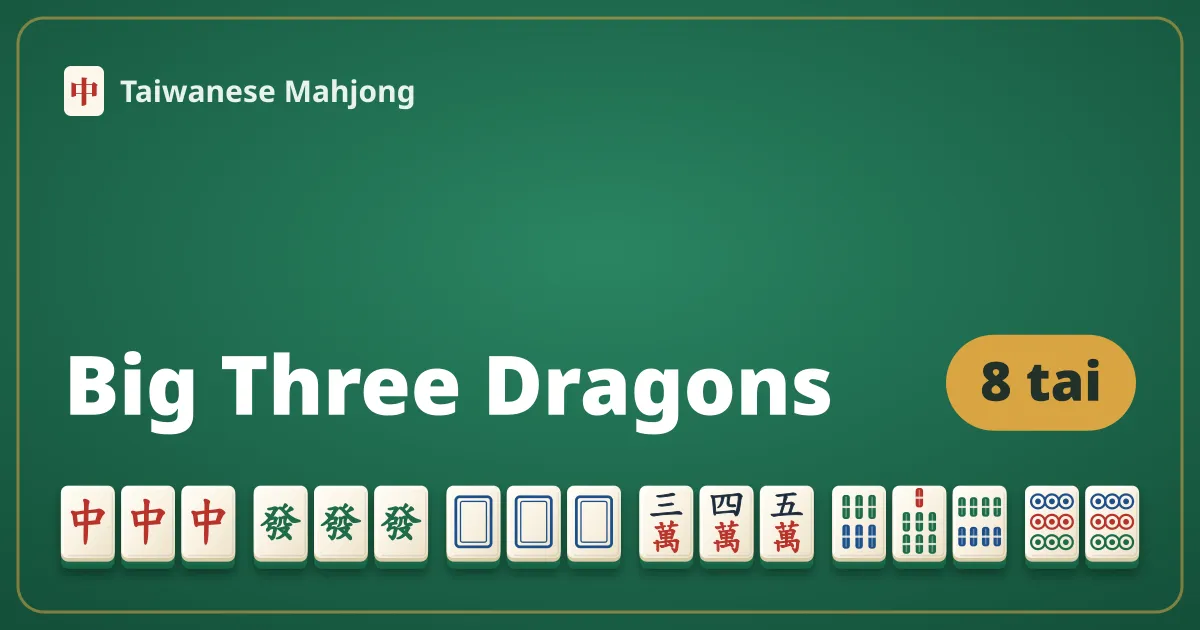 Big Three Dragons 8 tai
Pungs of all three dragons — an 8-tai big hand. Examples, scoring combos, and what your opening hand needs.
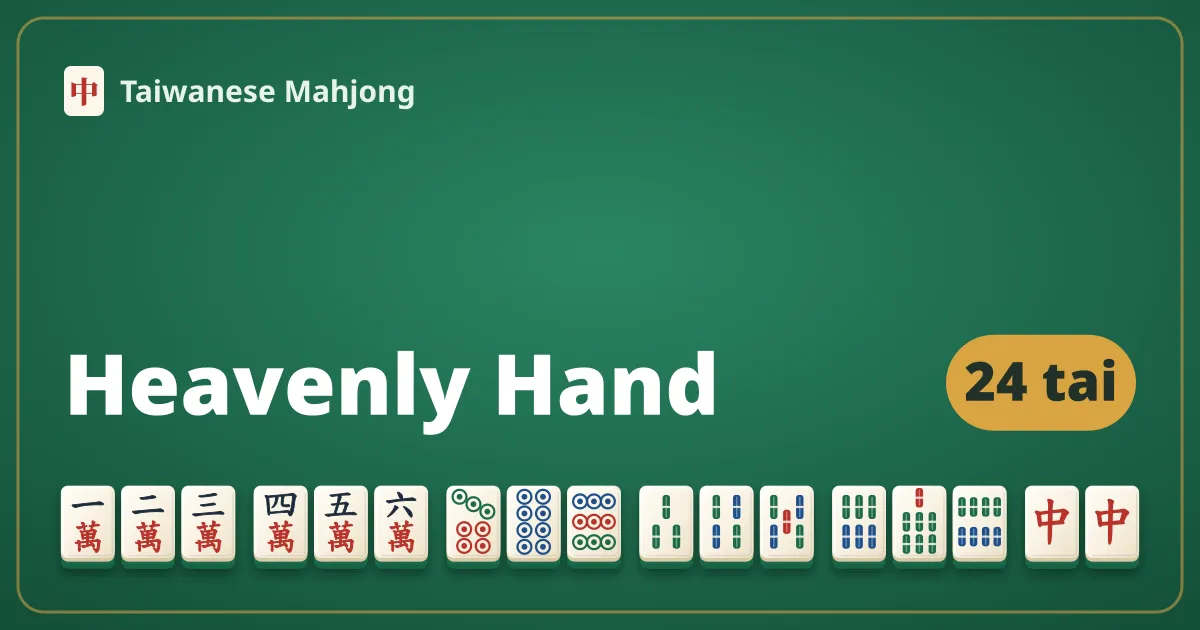 Heavenly Hand 24 tai
The dealer wins on the deal, 24 tai: no self-draw or concealed tai on top, and the exact odds are about one in a million.
Try it at the table
Taiwanese Mahjong — Play authentic Taiwanese 16-tile mahjong free in your browser against three computer opponents. Flowers, chow, pung, kong, dealer streaks and automatic tai scoring. No sign-up, works on phone and desktop.