Taiwanese Mahjong · 1 tai
Single Wait (Du Ting) in Taiwanese Mahjong: Tai, Examples and Odds
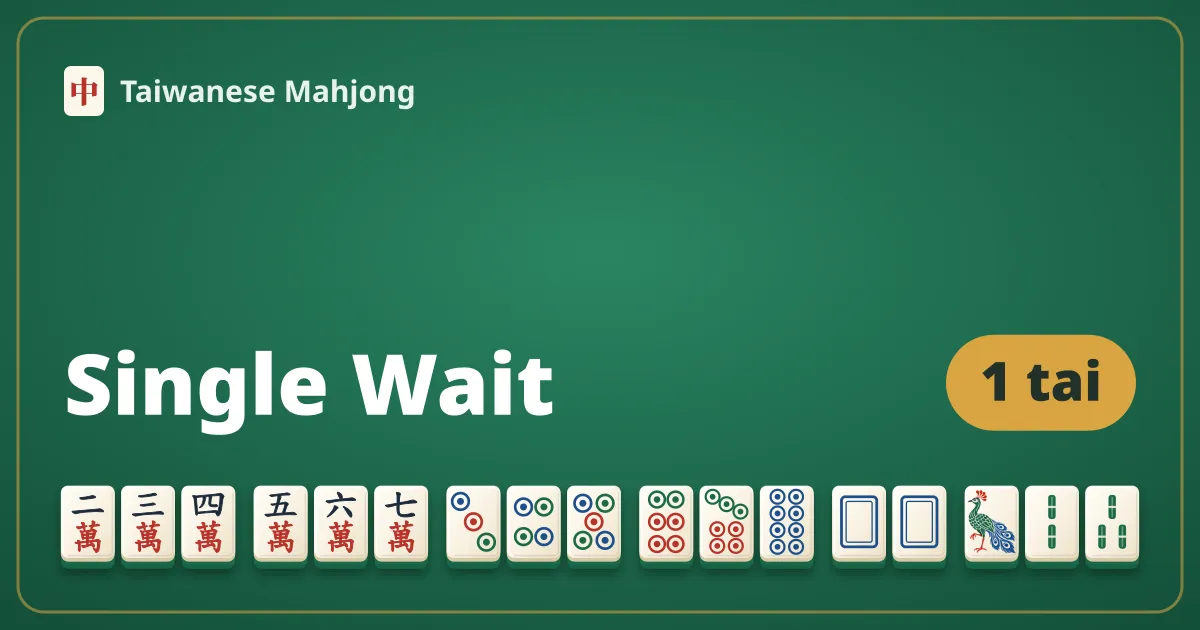
In Taiwanese mahjong, a single wait (獨聽, du ting) is worth 1 tai: when your hand is ready, only one kind of tile can win. The usual shapes are the edge wait (1-2 waiting on 3, 8-9 waiting on 7), the closed wait (for example 1-3 waiting on 2) and the pair wait (a lone tile waiting for its match). What counts is "only one kind", not the shape: a hand that looks like a pair wait but also wins on another tile is not a single wait.
On this page
The rules for Single Wait
- Before the win, exactly one kind of tile completes your hand (no matter how many of it are left)
- Counts on a discard or a self-draw
- All five sets claimed (All Exposed, Half Exposed) is always a pair wait, but does not add single wait
- Heavenly, Earthly and Human hands don't add it either
The three common single waits
The tai below are computed live by the same scoring code the game uses (dealer and dealer-streak tai are added on top). All three hands chowed 2-3-4 characters first, so none of them is concealed.
Edge wait: 1-2 waiting on 3, 8-9 waiting on 7
Won on a discard
| Single wait (獨聽) | 1 |
| Total | 1 tai |
|---|
Dealer and dealer-streak tai are added on top.
Closed wait: the middle tile is missing
Won on a discard
| Single wait (獨聽) | 1 |
| Total | 1 tai |
|---|
Dealer and dealer-streak tai are added on top.
Pair wait: waiting for the pair
Won on a discard
| Single wait (獨聽) | 1 |
| Total | 1 tai |
|---|
Dealer and dealer-streak tai are added on top.
Looks like a single wait, but isn't
Four connected tiles often wait on more than one tile:
Won on a discard
| Dragon pung (三元牌) | 1 |
| Total | 1 tai |
|---|
Dealer and dealer-streak tai are added on top.
Other common cases:
- Two-pair wait (two pairs, either can become a pung): two tiles, not a single wait.
- 3-4-5-5: 3-4-5 plus a pair wait on 5, or 5-5 as the pair with 3-4 waiting on 2 or 5 — it waits on 2 and 5, not a single wait.
- 1-3-3-3: 3-3-3 plus a pair wait on 1, or 3-3 as the pair with 1-3 waiting on 2 — it waits on 1 and 2, not a single wait.
On the other hand, 1-3-5-5 can only be 5-5 as the pair with 1-3 waiting on 2: one tile, a single wait.
The test is simple: try every tile against the hand before the win; if only one kind completes it, it's a single wait.
How Single Wait is scored
| Combination | Tai |
|---|---|
| Single wait | 1 |
| Single wait + concealed hand | 2 |
| Single wait + self-drawn | 2 |
| Single wait + concealed self-draw | 4 |
| Single wait + four concealed pungs | 6 |
How it relates to other hands
- Ping Hu: ping hu needs a two-sided wait, so single wait and ping hu never come together.
- All Exposed, Half Exposed: with all five sets claimed, one tile is left, so it's always a pair wait; the tai are already in all exposed / half exposed, and single wait isn't added.
- All Pungs and concealed pungs: five pungs done and waiting for the pair is a single wait — and because the winning tile is the pair, no pung turns exposed, so even a discard win keeps every concealed pung.
- Concealed Self-Draw, concealed hand: concealed single, edge or closed waits add single wait as usual.
Single Wait odds
We let four computers play 12,000 hands on this site's table (normal level); 11,677 of them ended with a win:
- Single waits were 33% of all wins — about one in three. The computers only care about speed and take whatever wait they get, and edge, closed and pair waits are simply common.
- Wins with a single wait averaged 2.2 tai for the whole hand; all wins averaged 1.6 tai.
- Of the single-wait wins, 26% were self-drawn; across all wins the self-draw share was 24%.
Should you settle for a single wait?
A single wait adds 1 tai, but leaves at most 4 winning tiles, against 8 for a two-sided wait:
- Switch to two-sided when you can: a two-sided wait wins roughly twice as often; the extra tai usually isn't worth it.
- A pair wait lets you choose: you can swap the tile you wait on. Pick one that has already shown up in the discards and that others are likely to throw (honors, or terminal 1s and 9s) rather than a tile nobody has seen.
- No choice? Take it: if you're stuck with 1-2, 8-9 or a closed wait and there's no time to improve, just wait — at least it's an extra tai.
To practise choosing waits, open a table of online Taiwanese mahjong — the computers play with you and count the tai for you.
Single Wait in other mahjong styles
- Chinese Official (Guobiao): Edge Wait, Closed Wait and Single Wait are 1 fan each (Guobiao fan list)
- Japanese mahjong: the wait shape is not a yaku; it only changes the fu (Japanese mahjong yaku list)
FAQ
How many tai is a single wait?
In Taiwanese mahjong a single wait is worth 1 tai, as long as only one kind of tile can win before you win.
Do edge, closed and pair waits all count?
Yes, as long as only one kind of tile wins. If the same hand can also win on another tile (like 1-2-3-4 bamboo waiting on 1 and 4), it doesn't count.
Does All Exposed also add single wait?
No. With all five sets claimed it's always a pair wait, and that's already part of All Exposed.
Is a two-pair wait a single wait?
No. Two pairs waiting for either to become a pung is two tiles.
Related hands
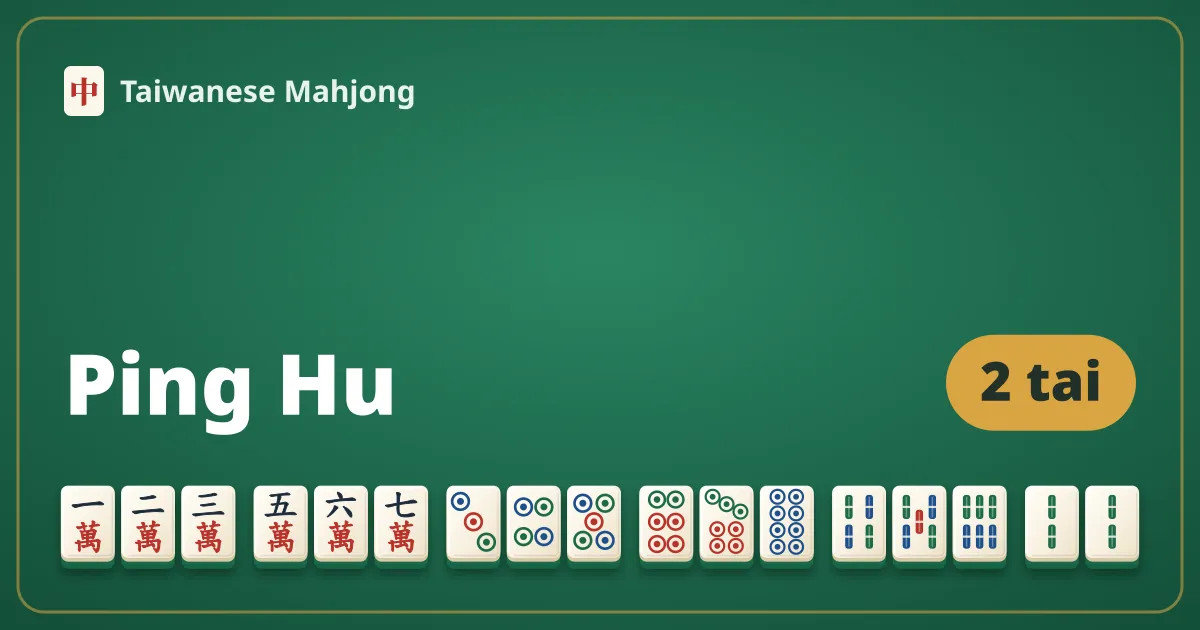 Ping Hu 2 tai
Five chows, no honors, no flowers, two-sided wait, no self-draw — a 2-tai hand. Checklist, common mistakes and odds.
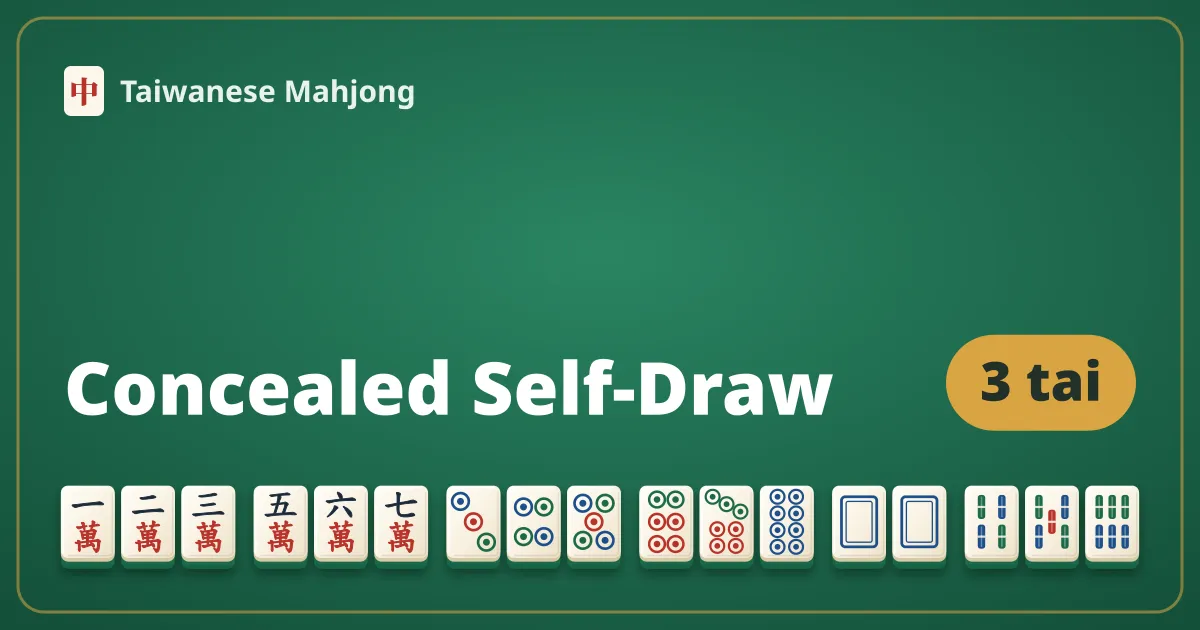 Concealed Self-Draw 3 tai
Never claim a tile and self-draw the win — 3 tai. Concealed hand vs self-draw, concealed kongs and replacement wins, and how often it happens.
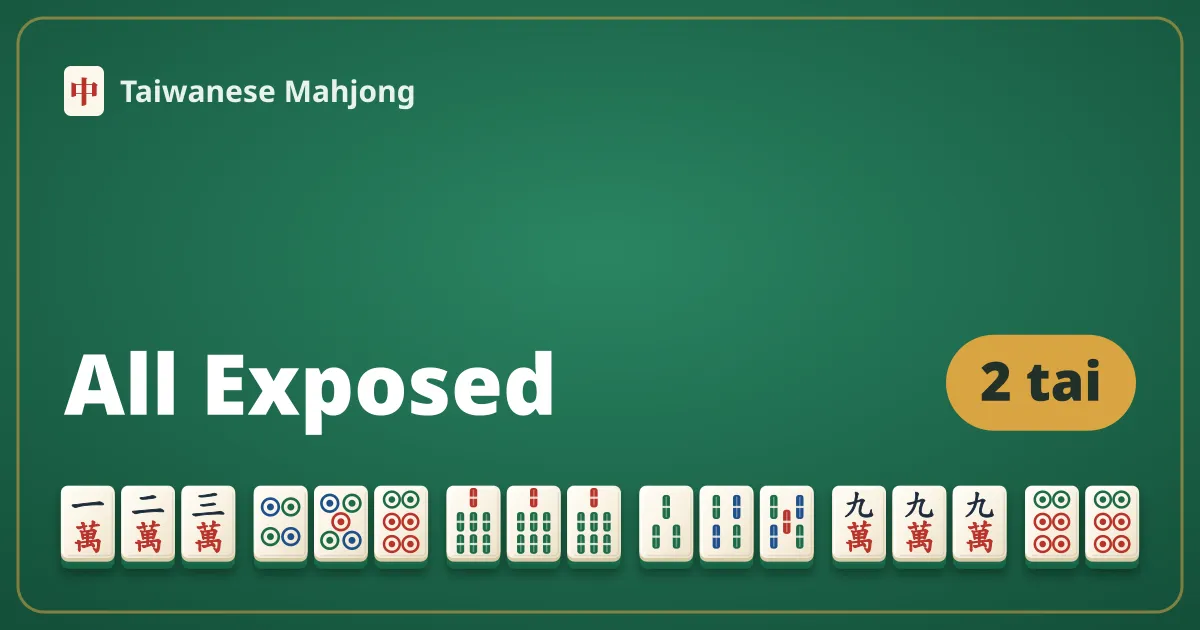 All Exposed 2 tai
All five sets claimed and a pair wait won on a discard: 2 tai. Half exposed vs all exposed, combos, and why it's rarely worth chasing.
Try it at the table
Taiwanese Mahjong — Play authentic Taiwanese 16-tile mahjong free in your browser against three computer opponents. Flowers, chow, pung, kong, dealer streaks and automatic tai scoring. No sign-up, works on phone and desktop.