Taiwanese Mahjong · 3 tai
Concealed Self-Draw (Bu Qiu Ren) in Taiwanese Mahjong: Tai, Examples and Odds
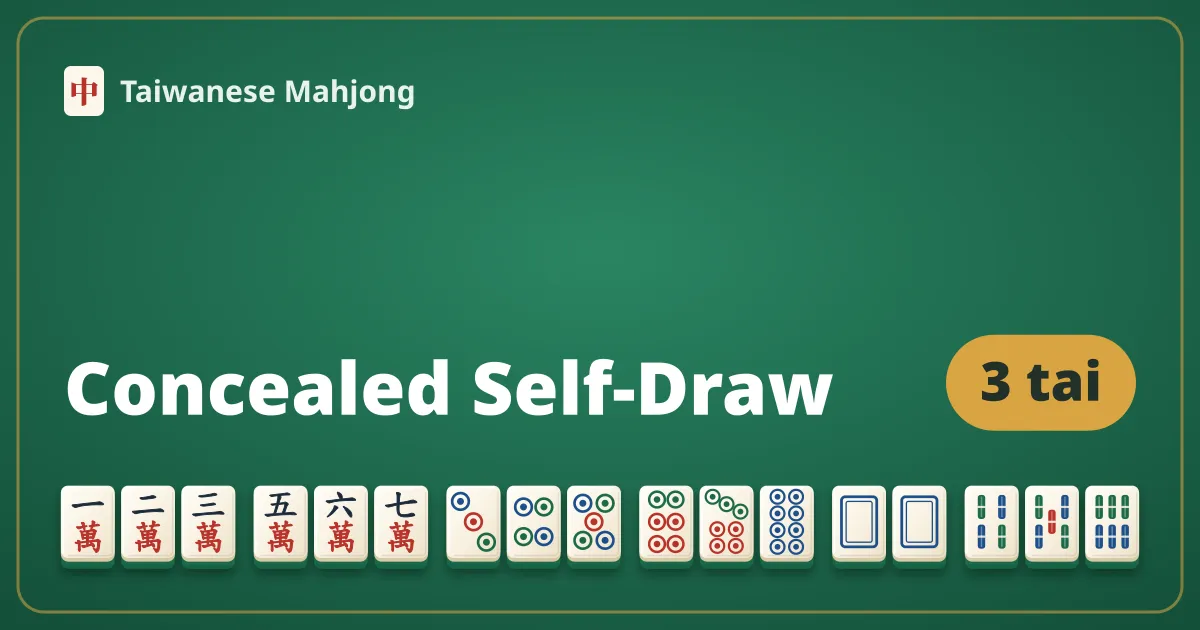
In Taiwanese mahjong, a concealed self-draw (不求人, bu qiu ren — "ask nobody") is worth 3 tai: from the deal to the win you never chow, pung or make an exposed kong, and the winning tile is your own draw as well — you never "ask" anyone for a single tile. It already includes the concealed hand and the self-draw; those two are not added again.
On this page
The rules for Concealed Self-Draw
- No chows, pungs, exposed kongs or added kongs anywhere in the hand
- The winning tile is your own draw — from the wall, or a replacement after a kong or flower
- Concealed kongs are fine: a concealed kong keeps the hand concealed, and a self-draw after it is still a concealed self-draw
- Flowers don't matter; replace them as usual
Concealed self-draw vs concealed hand vs self-draw
| Claimed sets? | How you win | Scores as | Tai |
|---|---|---|---|
| No | Self-drawn | Concealed self-draw | 3 |
| No | On a discard | Concealed hand | 1 |
| Yes | Self-drawn | Self-drawn | 1 |
| Yes | On a discard | Nothing | 0 |
Many tables describe it as "concealed 1 + self-draw 1 + bu qiu ren 1" — the total is the same 3 tai. This site scores it as a single item.
How Concealed Self-Draw is scored
The tai below are computed live by the same scoring code the game uses (dealer and dealer-streak tai are added on top).
Self-drawn
| Concealed self-draw (不求人) | 3 |
| Total | 3 tai |
|---|
Dealer and dealer-streak tai are added on top.
Self-drawn
| Concealed self-draw (不求人) | 3 |
| Single wait (獨聽) | 1 |
| Total | 4 tai |
|---|
Dealer and dealer-streak tai are added on top.
Self-drawn
| Concealed self-draw (不求人) | 3 |
| Win on a replacement tile (槓上開花) | 1 |
| Total | 4 tai |
|---|
Dealer and dealer-streak tai are added on top.
Common combinations:
| Combination | Tai |
|---|---|
| Concealed self-draw | 3 |
| Concealed self-draw + single wait | 4 |
| Concealed self-draw + win on a replacement tile | 4 |
| Concealed self-draw + last tile self-draw | 4 |
| Concealed self-draw + three concealed pungs | 5 |
| Concealed self-draw + Half One Suit | 7 |
How it relates to other hands
- Ping Hu: ping hu must be won on a discard, so a concealed self-draw never has ping hu. A concealed ping hu shape scores concealed + ping hu = 3 tai on a discard, and concealed self-draw = 3 tai when self-drawn — exactly the same.
- Concealed pungs: on a concealed self-draw every pung was drawn by you, so all of them are concealed pungs. A concealed hand with several pungs often picks up three concealed pungs or more on the self-draw.
- Single Wait: a single, edge or closed wait self-drawn adds single wait, 1 tai.
- Win on a replacement tile, last tile self-draw: self-drawing a replacement after a concealed kong or flower, or the last tile of the wall, adds 1 tai each.
- Heavenly and Earthly hands: the dealer winning on the deal, or a non-dealer self-drawing on the first draw, are concealed self-draws too, but score as Heavenly / Earthly hand instead.
Concealed Self-Draw odds
We let four computers play 12,000 hands on this site's table (normal level); 11,677 of them ended with a win:
- Concealed self-draws were 2.8% of all wins; self-draws with claimed sets were 22%, and all self-draws together 24%.
- Wins with a concealed self-draw averaged 4.0 tai for the whole hand; all wins averaged 1.6 tai.
- The computers on this site play fast and chow and pung whenever they can, so concealed self-draws are rare. Human players keep their hands concealed more, so the share is usually higher.
How to make Concealed Self-Draw
- A tidy start helps most: lots of partial sets and close to ready means you can get there without claiming.
- Don't rush to claim: a chow saves one tile but turns a 3-tai self-draw into a 1-tai one.
- Pick the wait with more tiles: self-drawing depends on what's left in the wall; a two-sided wait is far easier to draw than a single, edge or closed wait.
- When to give up: others have several sets exposed and look ready while you're still two or three tiles away — then claim for speed or start defending instead of insisting on staying concealed.
To practise, open a table of online Taiwanese mahjong — the computers play with you and count the tai for you.
Concealed Self-Draw in other mahjong styles
- Japanese mahjong: a concealed self-draw is "Menzen Tsumo", 1 han (Japanese mahjong yaku list)
- Hong Kong mahjong: concealed hand 1 fan plus self-drawn 1 fan (Hong Kong mahjong fan list)
- Chinese Official (Guobiao): "Fully Concealed Hand", 4 fan, which includes the self-draw and the concealed hand (Guobiao fan list)
FAQ
How many tai is a concealed self-draw?
In Taiwanese mahjong a concealed self-draw (bu qiu ren) is worth 3 tai, which includes the concealed hand and the self-draw.
Is bu qiu ren the same as a concealed self-draw?
Yes. Bu qiu ren means a concealed self-draw: nothing chowed or punged, and the winning tile drawn yourself too.
Does a self-draw after a concealed kong count?
Yes. A concealed kong doesn't break the concealed hand; if the winning tile is the replacement drawn after the kong, add win on a replacement tile for 1 tai.
Can a concealed self-draw also score ping hu?
No. Ping hu must be won on someone else's discard, so a self-draw never has it.
Related hands
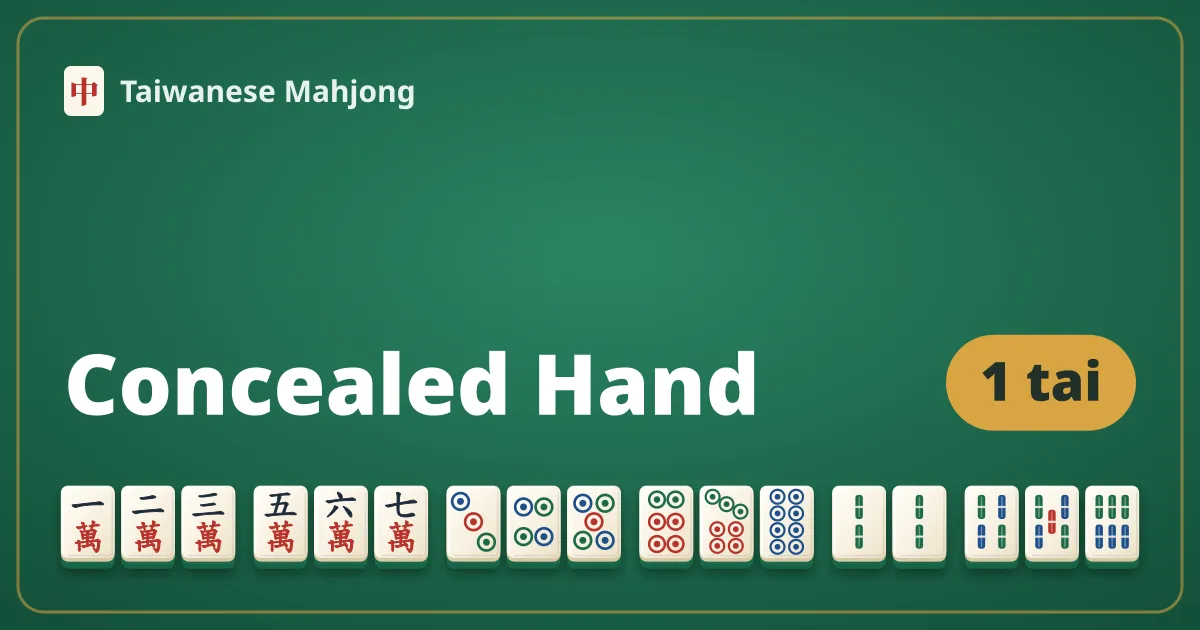 Concealed Hand 1 tai
No chows or pungs, won on a discard — 1 tai. Concealed kongs, the difference from concealed self-draw, and when staying concealed pays.
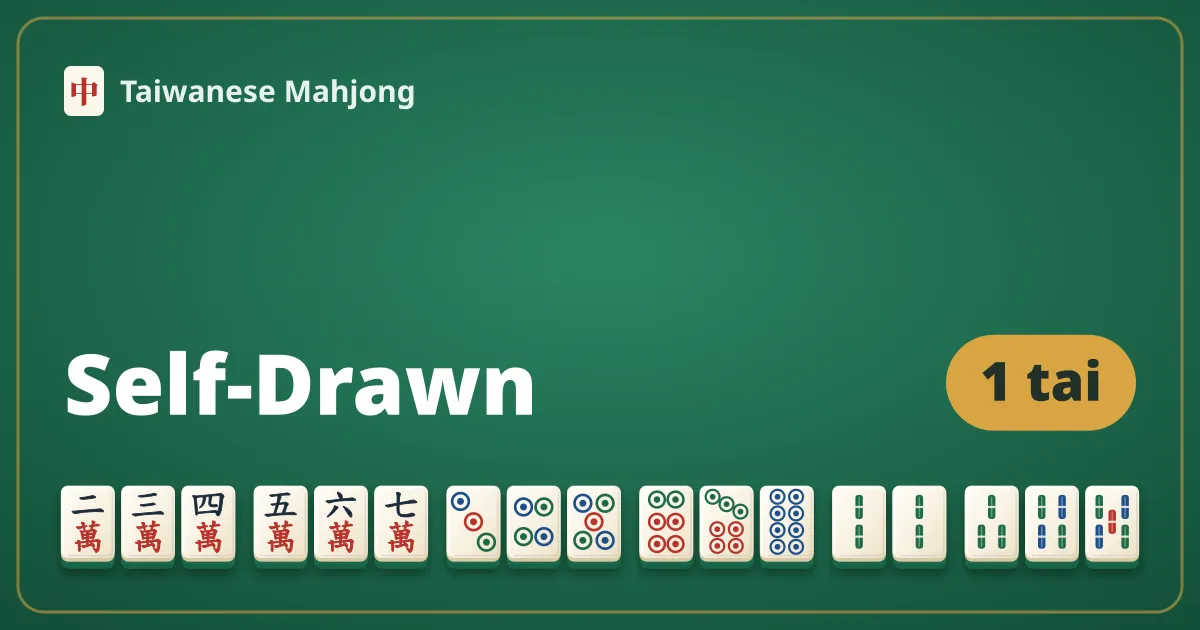 Self-Drawn 1 tai
Drawing your own winning tile — 1 tai, paid by all three opponents. Self-draw vs concealed self-draw, scoring combos and how often it happens.
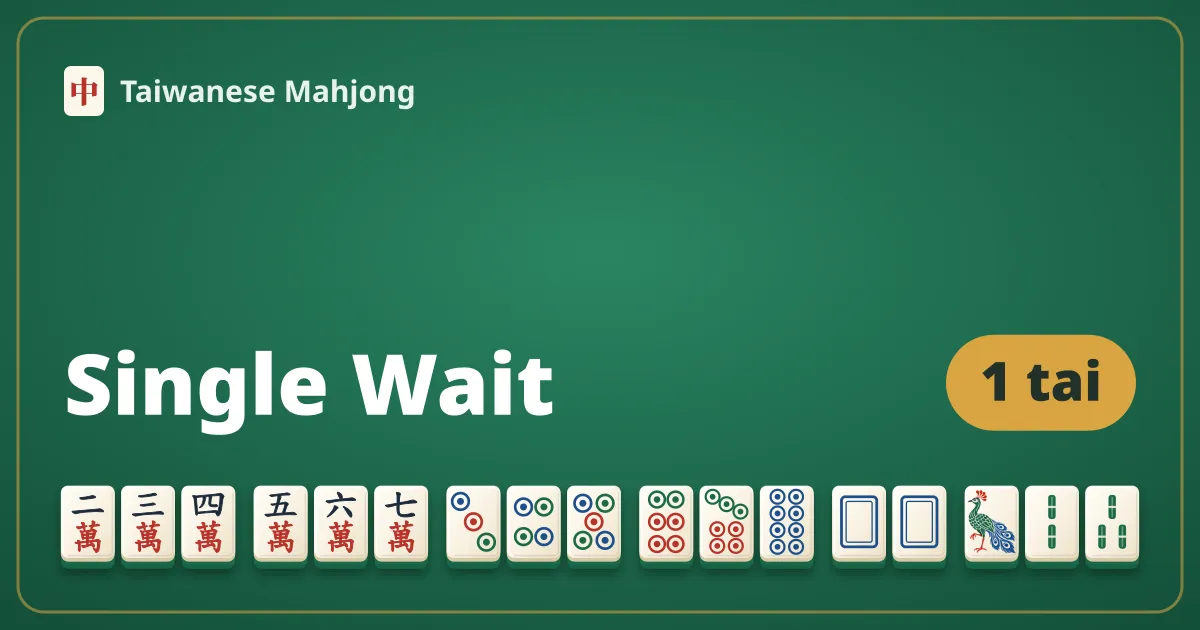 Single Wait 1 tai
Only one tile can win — 1 tai. Edge, closed and pair waits, false single waits, and how often it happens.
Try it at the table
Taiwanese Mahjong — Play authentic Taiwanese 16-tile mahjong free in your browser against three computer opponents. Flowers, chow, pung, kong, dealer streaks and automatic tai scoring. No sign-up, works on phone and desktop.