Taiwanese Mahjong · 1 tai
Self-Drawn (Zi Mo) in Taiwanese Mahjong: Tai, Examples and Odds
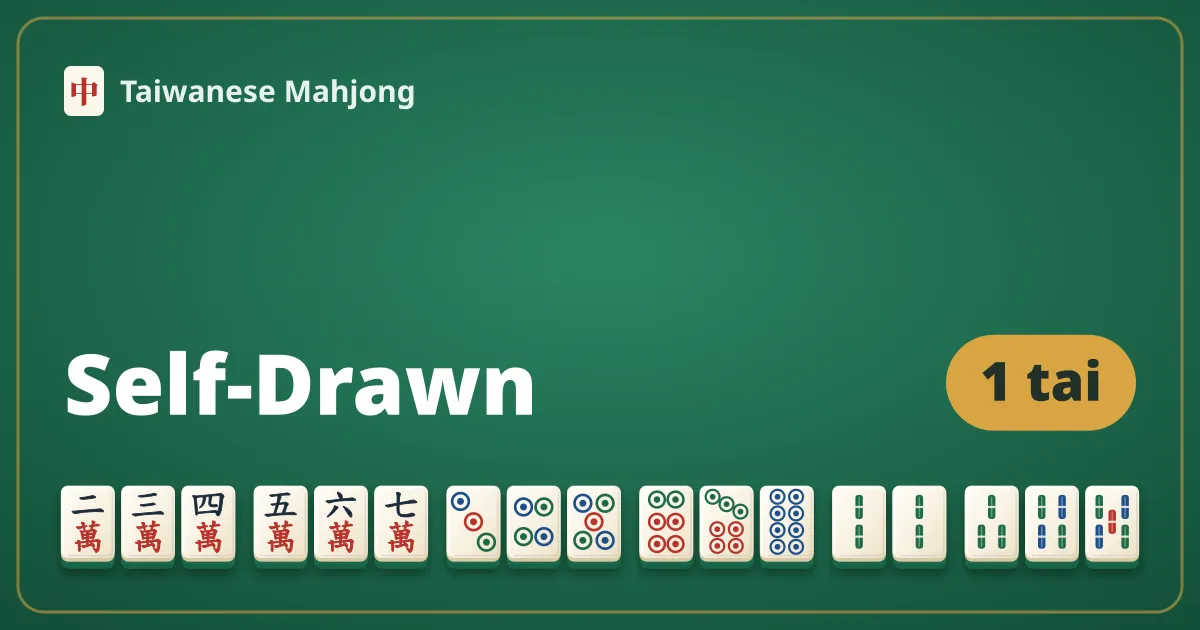
In Taiwanese mahjong, a self-drawn win (自摸, zi mo) is worth 1 tai: the winning tile is one you drew from the wall yourself, not someone else's discard. On a self-draw all three other players pay, unlike a win on a discard, where only the discarder pays. If you never claimed anything (a concealed hand) and then self-draw, it is not "1 tai for self-draw" — it becomes a concealed self-draw (不求人) worth 3 tai.
On this page
The rules for Self-Drawn
- The winning tile is one you drew: from the wall, or a replacement tile after a kong or a flower
- You already have chowed, punged or exposed-kong sets; a fully concealed self-draw scores as Concealed Self-Draw instead
- A concealed kong is not a claim: with only concealed kongs and no claims, a self-draw is still a concealed self-draw
- Anything discarded by someone else (including robbing a kong) is not a self-draw
Self-draw vs concealed self-draw
| Situation | Scores as | Tai |
|---|---|---|
| Claimed sets, self-drawn | Self-drawn | 1 |
| Nothing claimed, won on a discard | Concealed hand | 1 |
| Nothing claimed, self-drawn | Concealed self-draw (不求人) | 3 |
Concealed self-draw already includes the concealed hand and the self-draw; the three are never added together. Many tables call it "concealed self-draw, three tai" — same thing.
How Self-Drawn is scored
The tai below are computed live by the same scoring code the game uses (dealer and dealer-streak tai are added on top).
Self-drawn
| Self-drawn (自摸) | 1 |
| Total | 1 tai |
|---|
Dealer and dealer-streak tai are added on top.
Self-drawn
| Concealed self-draw (不求人) | 3 |
| Total | 3 tai |
|---|
Dealer and dealer-streak tai are added on top.
Self-drawn
| Self-drawn (自摸) | 1 |
| Single wait (獨聽) | 1 |
| Dragon pung (三元牌) | 1 |
| Total | 3 tai |
|---|
Dealer and dealer-streak tai are added on top.
Common combinations:
| Combination | Tai |
|---|---|
| Self-drawn | 1 |
| Self-drawn + single wait | 2 |
| Self-drawn + last tile self-draw | 2 |
| Self-drawn + win on a replacement tile | 2 |
| Self-drawn + all claimed, self-drawn | 2 |
| Concealed self-draw | 3 |
How it relates to other hands
- Concealed Self-Draw, Concealed Hand: a concealed self-draw scores 3 tai and replaces both self-draw and concealed hand.
- Ping Hu: ping hu must be won on a discard, so a self-draw never has ping hu. A ping hu shape that is self-drawn keeps only the self-draw (or concealed self-draw) tai.
- Concealed pungs: a pung completed by your own draw counts as concealed; one completed by a discard does not. With a two-pair wait, a self-draw often adds a concealed pung — that's how most three and four concealed pungs happen.
- Last Tile Draw, win on a replacement tile: self-drawing the last tile of the wall, or a replacement tile after a kong or flower, adds 1 tai each — both require a self-draw.
- Half Exposed: all five sets claimed and a single wait self-drawn adds the half-exposed tai on top of the self-draw.
- Heavenly and Earthly hands: the dealer winning on the deal, or a non-dealer self-drawing on the very first draw, score as Heavenly / Earthly hand instead; the self-draw is not added.
Self-drawn odds
We let four computers play 12,000 hands on this site's table (normal level); 11,677 of them ended with a win:
| How the hand was won | Share of all wins |
|---|---|
| All self-draws (incl. concealed) | 24% |
| Self-drawn (with claimed sets) | 22% |
| Concealed self-draw | 2.8% |
- Roughly one win in four is self-drawn; the rest are won on a discard.
- Most self-draws come after claiming: the computers on this site play fast and chow and pung whenever they can, so concealed self-draws are much rarer than self-draws with claimed sets.
- Wins that included a self-draw averaged 2.3 tai for the whole hand; all wins averaged 1.6 tai.
How to self-draw more often
- Wait on more tiles: a two-sided wait (say 4-5 bamboo waiting on 3 or 6) has 8 winning tiles; a single, edge or closed wait has 4 at most. Self-drawing depends on how many are left in the wall.
- Watch the discards: if several of your tiles are already discarded or punged, fewer are left to draw; when you can switch waits, switch to the one with more left.
- Claim later: with a concealed hand a self-draw is 3 tai, after claiming only 1 tai. When there's no hurry, keeping the hand concealed often pays.
- Wait for a self-draw while defending: when someone else is ready and you don't dare discard dangerous tiles, play safe tiles and keep your own wait for a self-draw instead of pushing and dealing in.
To feel the difference between self-draws and discard wins, open a table of online Taiwanese mahjong — the computers play with you and count the tai for you.
Self-drawn in other mahjong styles
- Japanese mahjong: "Menzen Tsumo" is 1 han and only counts with a concealed hand; an open self-draw is not a yaku (Japanese mahjong yaku list)
- Hong Kong mahjong: self-drawn is 1 fan (Hong Kong mahjong fan list)
- Chinese Official (Guobiao): self-drawn is 1 fan; a concealed self-draw is "Fully Concealed Hand", 4 fan (Guobiao fan list)
FAQ
How many tai is a self-drawn win?
In Taiwanese mahjong a self-draw is worth 1 tai and all three opponents pay. A concealed self-draw scores 3 tai instead.
Who pays on a self-draw?
All three other players. Each pays the base plus tai × the per-tai stake, and any payment involving the dealer adds the dealer tai.
Is a concealed self-draw 1 tai or 3?
This site scores it as concealed self-draw (不求人), 3 tai, which already includes the concealed hand and the self-draw. That's also the common Taiwanese rule: "concealed self-draw, three tai".
Can a self-draw be ping hu?
No. Ping hu must be won on someone else's discard, so a self-draw never scores it.
Does winning on a kong or flower replacement count as self-drawn?
Yes. The replacement tile is still your own draw, so the self-draw counts, plus win on a replacement tile for 1 tai.
Related hands
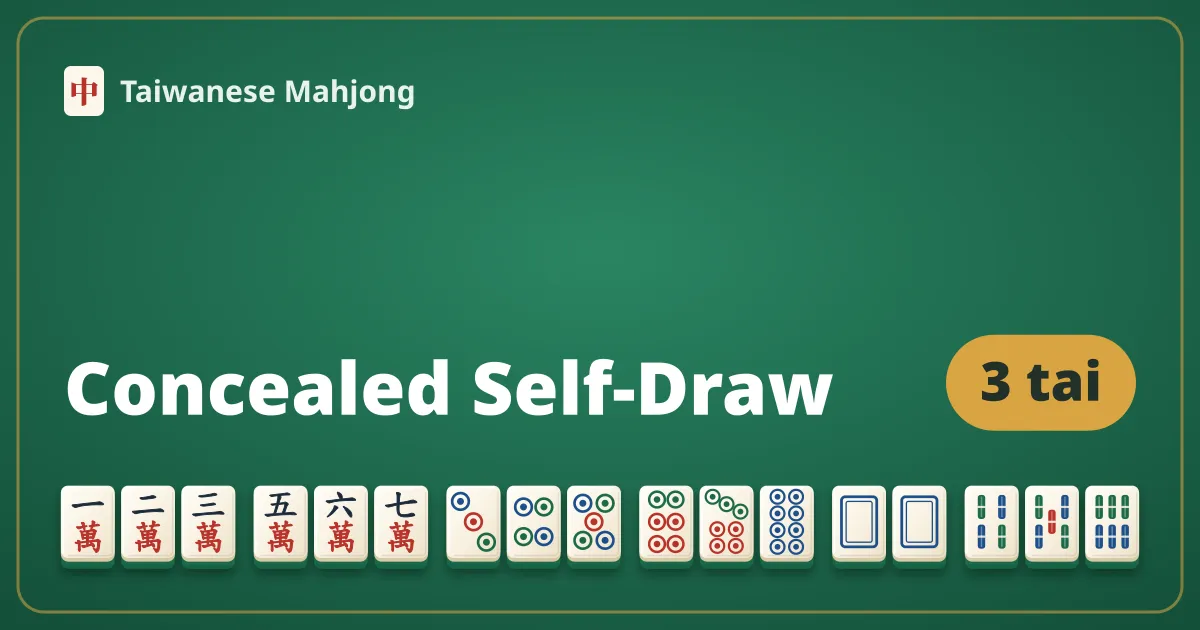 Concealed Self-Draw 3 tai
Never claim a tile and self-draw the win — 3 tai. Concealed hand vs self-draw, concealed kongs and replacement wins, and how often it happens.
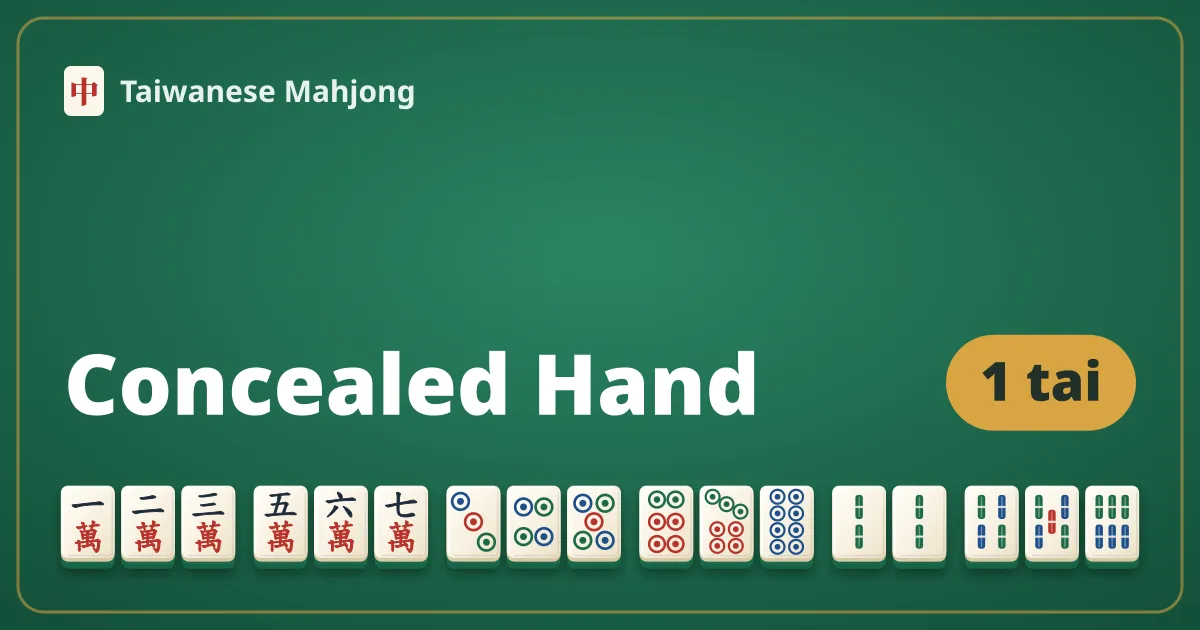 Concealed Hand 1 tai
No chows or pungs, won on a discard — 1 tai. Concealed kongs, the difference from concealed self-draw, and when staying concealed pays.
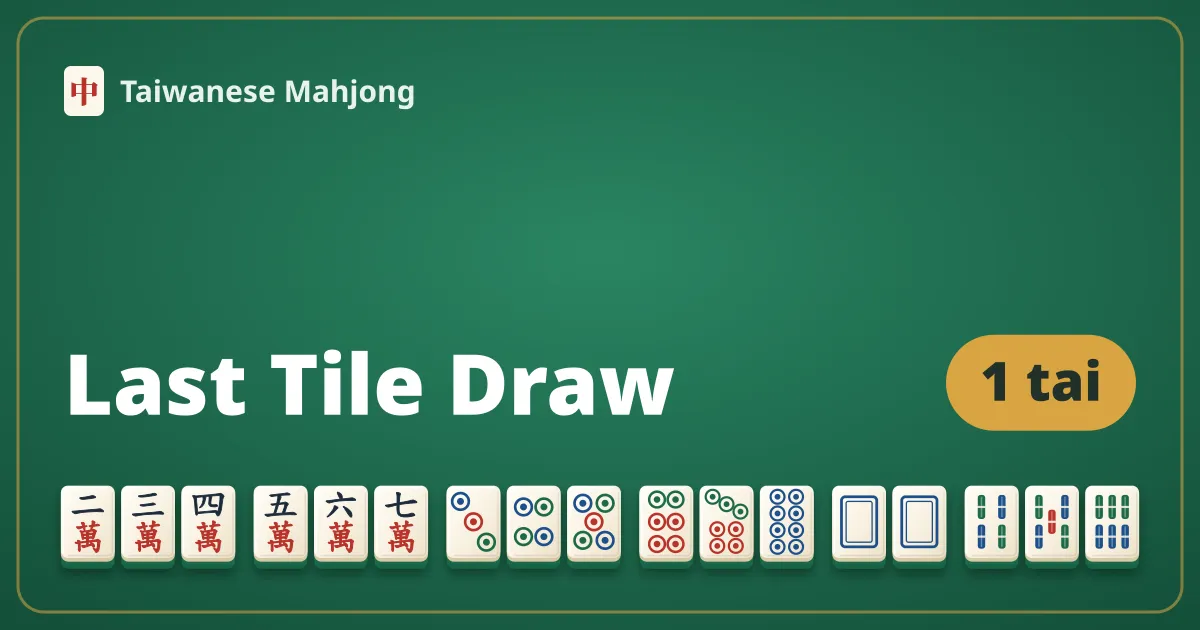 Last Tile Draw 1 tai
Self-draw the last tile of the wall for 1 extra tai: which tile is the last one, the difference from a last-discard win, and how rare it is.
Try it at the table
Taiwanese Mahjong — Play authentic Taiwanese 16-tile mahjong free in your browser against three computer opponents. Flowers, chow, pung, kong, dealer streaks and automatic tai scoring. No sign-up, works on phone and desktop.