Taiwanese Mahjong · 1 tai
Last Discard Win (He Di Lao Yu) in Taiwanese Mahjong: Tai, Rules and Odds
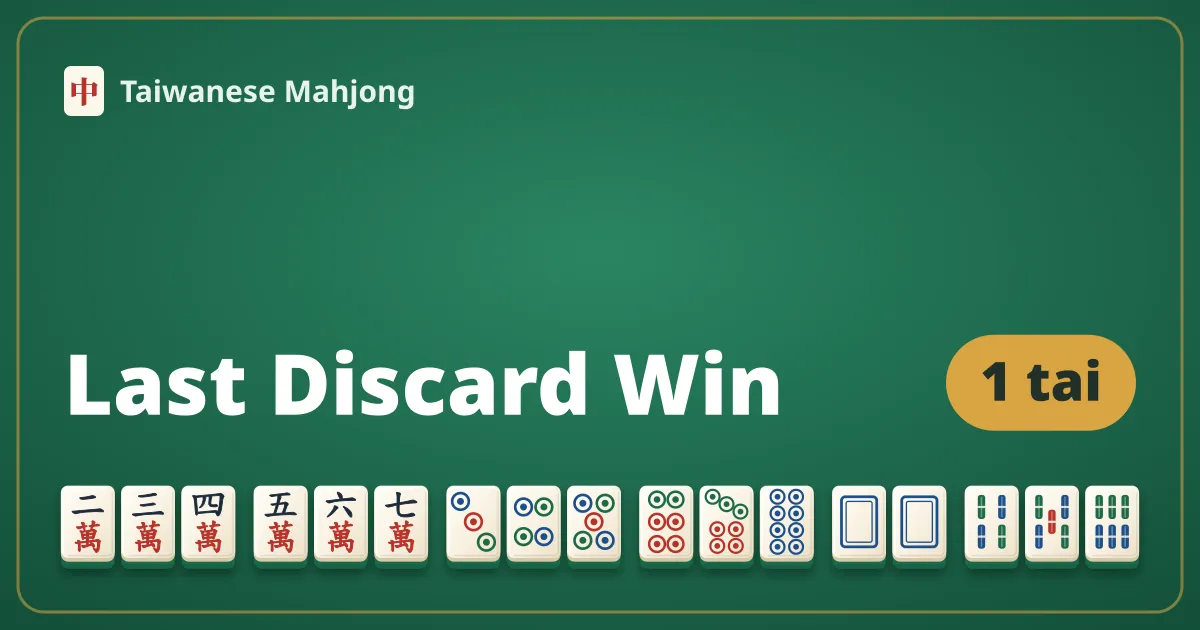
In Taiwanese mahjong, Last Discard Win (河底撈魚, he di lao yu) is worth 1 tai: the last drawable tile of the wall has been taken, the player who drew it didn't win and discards — and you win on that discard. The "river" is the discard area; you fish the last tile out of it.
On this page
The rules for Last Discard Win
- The wall is down to its last drawable tile (this site keeps 16 tiles, 8 stacks, back; that point counts as the end)
- The player who drew it didn't self-draw a win and discarded
- You win on that discard: a win on a discard, not a self-draw
- Any hand shape counts; it doesn't have to be concealed
The rules for the last tile
Once the last discard is made there is nothing left to draw, so:
- No chow, pung or kong: a chow or pung needs another discard, a kong needs a replacement tile. The tile can only be won on; if nobody wins, the hand is a draw.
- Head bump: this site doesn't allow multiple winners. If two players can win, the one next in turn after the discarder takes it.
- Passed wins still apply: a player who passed up a win this go-around can't win on it.
How Last Discard Win is scored
Last Discard Win is a "timing" tai and stacks with everything your hand scores. The tai below are computed live by the same scoring code the game uses (dealer and dealer-streak tai are added on top).
Won on a discard
| Last discard win (河底撈魚) | 1 |
| Total | 1 tai |
|---|
Dealer and dealer-streak tai are added on top.
Won on a discard
| Concealed hand (門清) | 1 |
| All runs, no honors or flowers (平胡) | 2 |
| Last discard win (河底撈魚) | 1 |
| Total | 4 tai |
|---|
Dealer and dealer-streak tai are added on top.
Common combinations:
| Combination | Tai |
|---|---|
| Last Discard Win | 1 |
| Last Discard Win + concealed hand | 2 |
| Last Discard Win + single wait | 2 |
| Last Discard Win + concealed hand + Ping Hu | 4 |
How it relates to other hands
- Last Tile Self-Draw: you draw the last tile and win yourself, 1 tai, plus self-draw or concealed self-draw. A hand can only be one of the two.
- Robbing a Kong: also a win on someone else's tile, but nobody can kong once the wall is empty, so the two never happen together.
- Ping Hu, concealed hand, single wait: these depend on your hand and stack with Last Discard Win. Ping Hu needs a win on a discard anyway, so the last tile can complete it.
Last Discard Win odds
Last Discard Win needs the hand to run all the way to the end of the wall, so it's rare. In 12,000 hands of four normal-level computers on this site, 41 of 11,677 wins were Last Discard Wins, 0.35%; Last Tile Self-Draw was 0.18%.
- Last Discard Win is more common than Last Tile Self-Draw because only the player who draws the last tile can self-draw it, while all three others can win on the discard.
- Hands with Last Discard Win averaged 2.4 tai in total.
How to play the last tile
If you draw the last tile and don't win, your discard can only be won on or end the hand in a draw — nobody can chow or pung it. So:
- Discard a safe tile: a tile that has already been discarded without anyone winning on it is safer (not guaranteed). Dealing in here also hands the winner an extra tai.
- Don't push a dangerous tile to stay ready: you can't win any more — there is no next draw — so staying ready is worthless.
To get a feel for the end of the wall, open a table of online Taiwanese mahjong — the computers play with you and count the tai for you.
Last Discard Win in other mahjong styles
Winning on the last discard exists everywhere, under different names and values:
- Japanese mahjong: "Houtei", 1 han (Japanese mahjong yaku list)
- Sichuan mahjong: "Last-tile discard", 1 fan (Sichuan mahjong fan list)
- Chinese Official (Guobiao): "Last Tile Claim", 8 fan; Guobiao's self-drawn last tile is a separate fan, "Last Tile Draw" (Guobiao fan list)
- Hong Kong mahjong doesn't separate the two: "Last tile", 1 fan, either way (Hong Kong mahjong fan list)
FAQ
How many tai is Last Discard Win?
In Taiwanese mahjong Last Discard Win is worth 1 tai, on top of whatever your hand scores — concealed hand, Ping Hu, single wait and so on.
What's the difference from Last Tile Self-Draw?
Both are about the last tile of the wall. Drawing it and winning yourself is Last Tile Self-Draw; the player who drew it discarding and you winning on that discard is Last Discard Win. Same tai, but Last Tile Self-Draw is a self-draw and also adds self-draw or concealed self-draw tai.
Can the last discard be punged?
No. There is nothing left to draw, so the last discard can only be won on; if nobody wins, the hand is a draw.
Why is "hai di lao yue" a discard win in Guobiao?
Names differ by style. Guobiao calls winning on the last discard "hai di lao yue" and self-drawing the last tile "miao shou hui chun"; in Taiwanese and Japanese mahjong "hai di" is the self-draw and "he di" (houtei) is the discard win.
Related hands
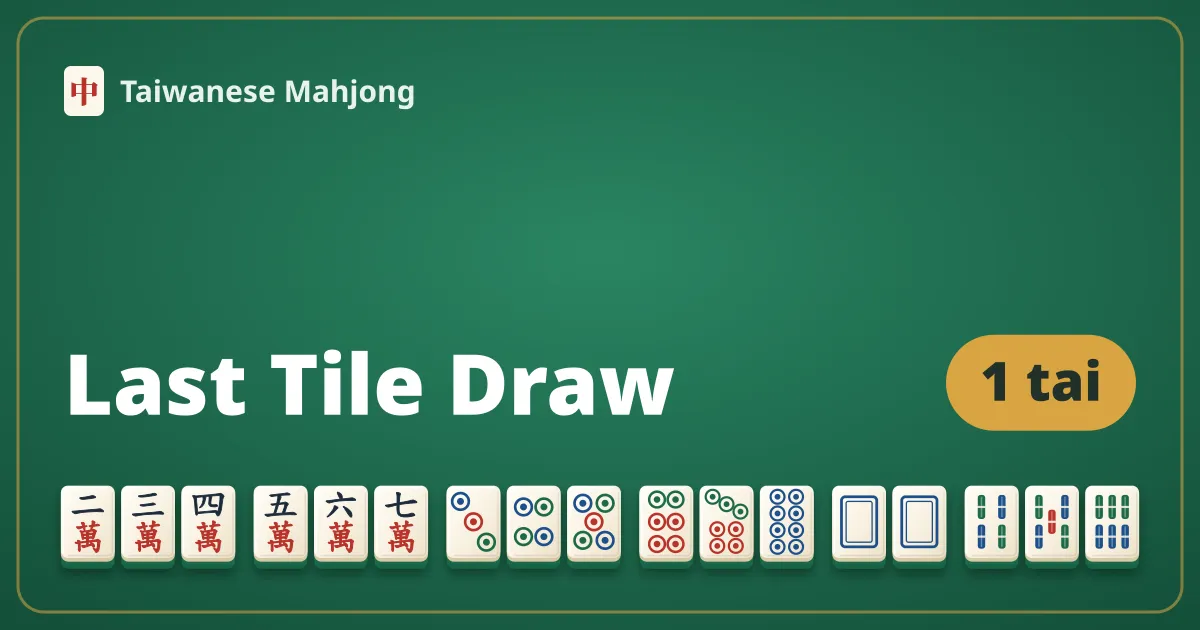 Last Tile Draw 1 tai
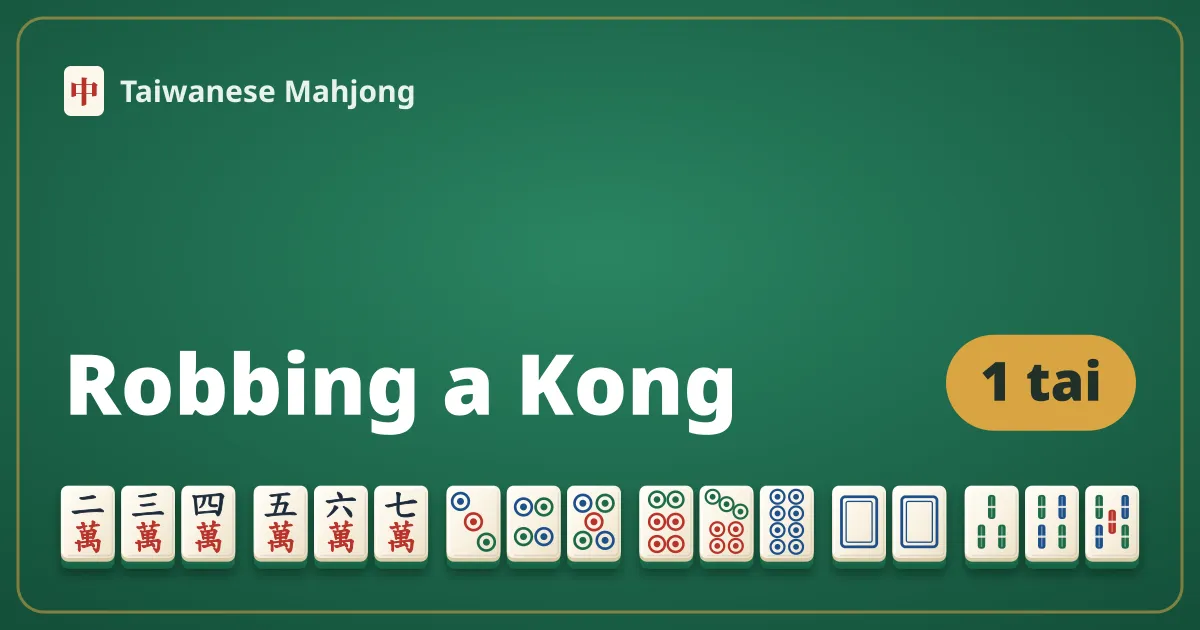 Robbing a Kong 1 tai
Try it at the table
Taiwanese Mahjong — Play authentic Taiwanese 16-tile mahjong free in your browser against three computer opponents. Flowers, chow, pung, kong, dealer streaks and automatic tai scoring. No sign-up, works on phone and desktop.