Taiwanese Mahjong · 2 tai
Three Concealed Pungs (San An Ke) in Taiwanese Mahjong: Tai, Examples and Odds
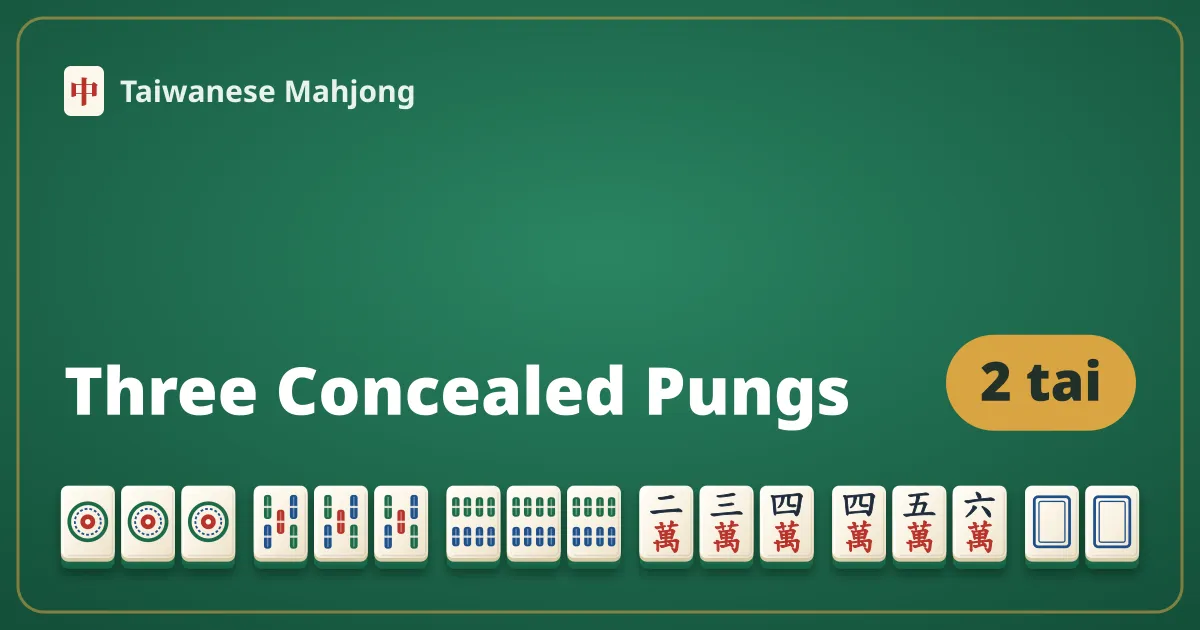
In Taiwanese mahjong, Three Concealed Pungs (三暗刻, san an ke) is worth 2 tai: when you win, your hand holds three concealed pungs — three identical tiles you drew yourself. A claimed pung is exposed and doesn't count; a concealed kong does.
On this page
The rules for Three Concealed Pungs
- Three pungs you drew yourself: pungs in your hand, or concealed kongs
- Claimed pungs, exposed kongs and added kongs (pung first, kong later) are exposed and don't count
- A pung completed by someone's discard is not concealed: with a two-pair wait, winning on a discard makes that set exposed
- The other two sets can be runs, and you may chow or pung them: the hand doesn't have to be concealed
Does winning on a discard cost you a concealed pung?
This is where Three Concealed Pungs is most often miscounted. What matters is which set the winning tile completes.
The winning tile completes a run or the pair: nothing changes
If your three pungs were already done and you wait on a run (two-sided, edge or closed) or a single tile for the pair, all three stay concealed even when you win on a discard.
Two-pair wait: the discard makes that pung exposed
You hold two pairs and wait for either one to become a pung. Self-draw it and the new pung is concealed; win it on a discard and it counts as exposed. The same hand can be a whole step apart depending on how it wins.
How Three Concealed Pungs is scored
The tai below are computed live by the same scoring code the game uses (dealer and dealer-streak tai are added on top).
Won on a discard
| Three concealed pungs (三暗刻) | 2 |
| Total | 2 tai |
|---|
Dealer and dealer-streak tai are added on top.
Won on a discard
| Three concealed pungs (三暗刻) | 2 |
| Total | 2 tai |
|---|
Dealer and dealer-streak tai are added on top.
Self-drawn
| Self-drawn (自摸) | 1 |
| Four concealed pungs (四暗刻) | 5 |
| Total | 6 tai |
|---|
Dealer and dealer-streak tai are added on top.
Common combinations:
| Combination | Tai |
|---|---|
| Three Concealed Pungs | 2 |
| Three Concealed Pungs + concealed hand | 3 |
| Three Concealed Pungs + concealed self-draw | 5 |
| Three Concealed Pungs + All Pungs | 6 |
| Three Concealed Pungs + Half One Suit | 6 |
How it relates to other hands
- Four and Five Concealed Pungs: the same family — four or five concealed pungs score 5 or 8 tai instead, never on top of three.
- All Pungs: all five sets are pungs. Three concealed plus two claimed pungs is Three Concealed Pungs + All Pungs, 6 tai.
- Concealed self-draw: a closed hand tends to hold more concealed pungs, and self-drawing a two-pair wait turns the last one concealed too.
- Dragon and wind pungs: if a concealed pung is a dragon, the round wind or your seat wind, those tai count as well.
Three Concealed Pungs odds
Pungs in the opening hand
A 16-tile opening hand already holds a pung (three or more of one tile) about 16% of the time, two pungs only 0.78%, and three 0.0086%. Most Three Concealed Pungs hands are built during play from pairs: a start with 4 or more pairs happens about 13% of the time.
| 16-tile opening hand | Chance |
|---|---|
| 1+ pungs | 16% |
| 2+ pungs | 0.78% |
| 3+ pungs | 0.0086% |
| 4+ pairs | 13% |
How common it is in real games
Four computers played 12,000 hands on this site's table. Of the 11,677 winning hands, 41 had Three Concealed Pungs, a share of 0.35%; those wins averaged 4.5 tai.
How to play for Three Concealed Pungs
- Hold your pairs instead of punging: a claimed pung is exposed. With three or four pairs whose tiles haven't been discarded, keep them and wait to draw.
- With two concealed pungs, the third is a bonus: the hand needn't be concealed, so keep chowing and punging other sets — don't slow down too much.
- Pick the right wait: once three pungs are done, a run or single wait is safer than a two-pair wait because a discard won't cost you one; a two-pair wait self-drawn jumps straight to four.
- Don't refuse good calls for it: it's only 2 tai, and speed is often worth more.
To practise when to pung and when to hold, open a table of online Taiwanese mahjong — the computers play with you and count the tai for you.
Three Concealed Pungs in other mahjong styles
- Japanese mahjong also has "Sanankou", 2 han; four concealed pungs is a yakuman (Japanese mahjong yaku list)
- Chinese Official (Guobiao) has Three Concealed Pungs for 16 fan and Two Concealed Pungs for 2 fan (Guobiao fan list)
- Hong Kong mahjong has no Three Concealed Pungs; only Four Concealed Pungs, as a limit hand (Hong Kong mahjong fan list)
FAQ
How many tai is Three Concealed Pungs?
In Taiwanese mahjong Three Concealed Pungs is worth 2 tai. It stacks with All Pungs, concealed hand, concealed self-draw, Half One Suit, dragon pungs and more; Four and Five Concealed Pungs are the same family, so only the highest counts.
Does a claimed pung count as concealed?
No. Punging takes someone else's discard, so the exposed pung isn't concealed. The same goes for exposed and added kongs; only a concealed kong counts.
Can a win on a discard still be Three Concealed Pungs?
Yes, as long as none of the three pungs was completed by that discard. Waiting on a run or a single tile keeps them all concealed; with a two-pair wait, the pung made from the discard becomes exposed.
Does Three Concealed Pungs require a concealed hand?
No. The other two sets can be chowed or punged; you only need three self-drawn pungs in hand.
Does a concealed kong count as a concealed pung?
Yes. You drew all four tiles yourself before declaring it, so it scores as a concealed pung and doesn't break a concealed hand.
Related hands
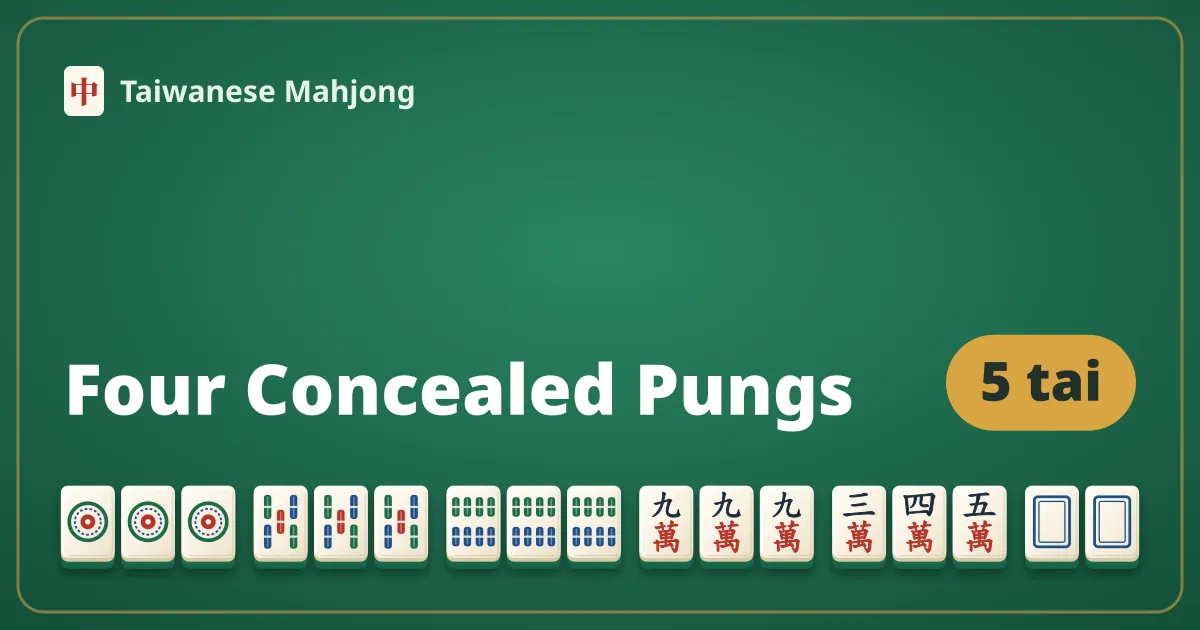 Four Concealed Pungs 5 tai
Four self-drawn pungs for 5 tai: a pung completed on a discard doesn't count, and one more makes five.
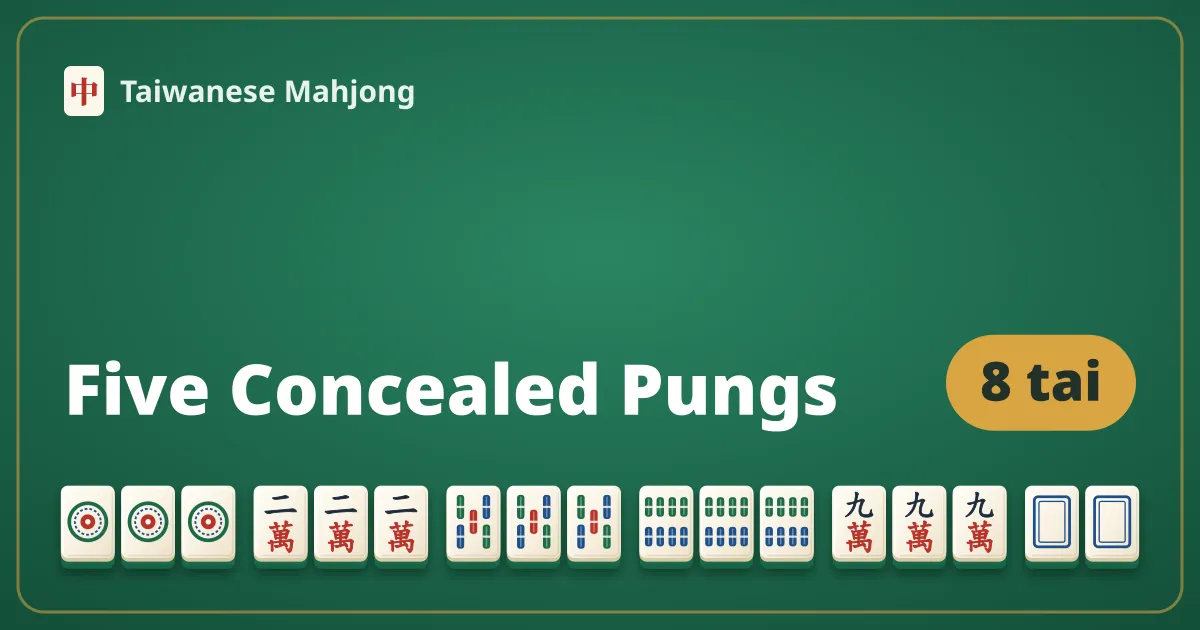 Five Concealed Pungs 8 tai
All five pungs self-drawn, an 8-tai big hand: always All Pungs too, and a single wait on a discard still counts.
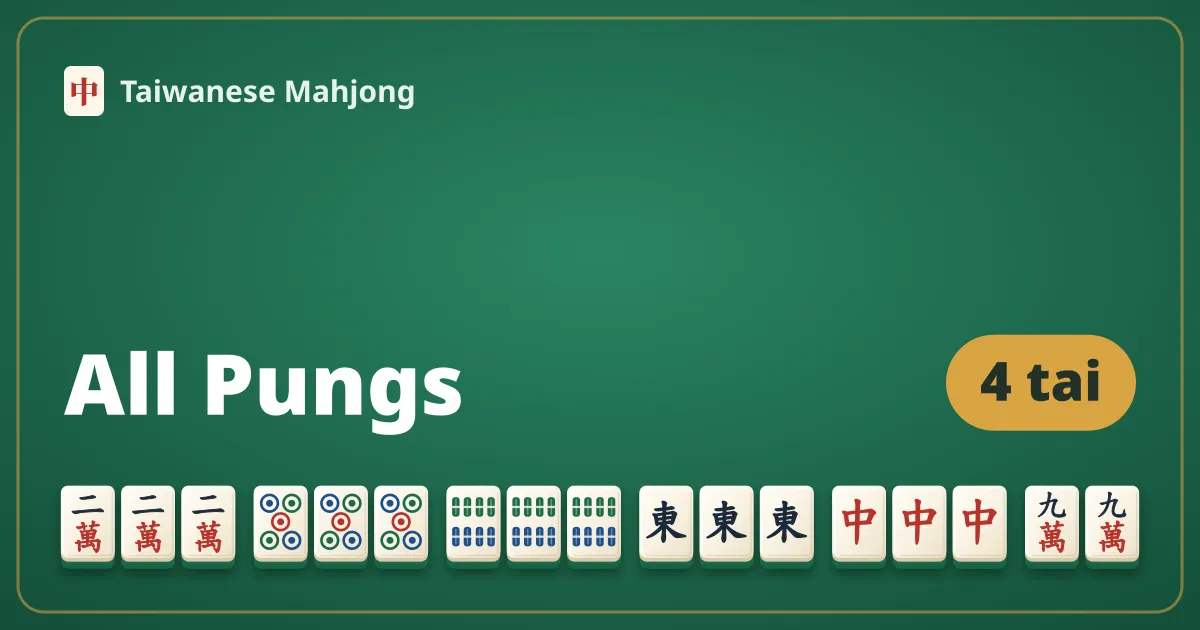 All Pungs 4 tai
Five pungs and a pair, no chows allowed — 4 tai. Examples, scoring combos and how many pairs you need to go for it.
Try it at the table
Taiwanese Mahjong — Play authentic Taiwanese 16-tile mahjong free in your browser against three computer opponents. Flowers, chow, pung, kong, dealer streaks and automatic tai scoring. No sign-up, works on phone and desktop.