Taiwanese Mahjong · 5 tai
Four Concealed Pungs (Si An Ke) in Taiwanese Mahjong: Tai, Examples and Odds
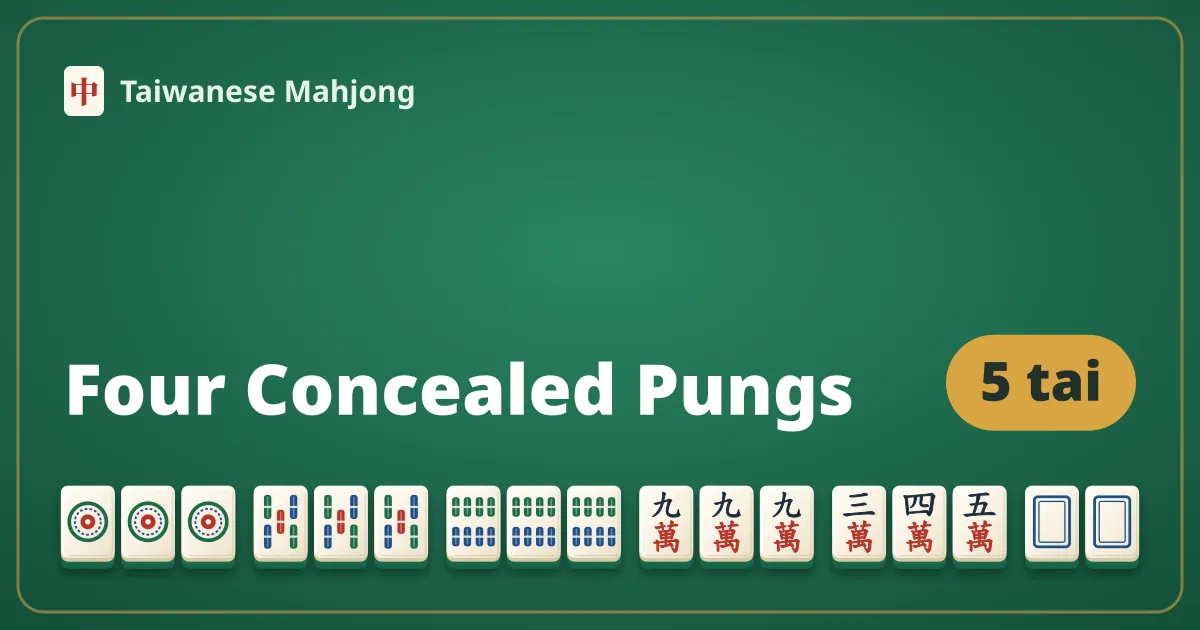
In Taiwanese mahjong, Four Concealed Pungs (四暗刻, si an ke) is worth 5 tai: when you win, four of your sets are pungs you drew yourself (concealed pungs). The fifth set can be a run, a claimed pung, or a pung completed by a discard.
On this page
The rules for Four Concealed Pungs
- Four pungs you drew yourself: pungs in your hand, or concealed kongs
- Claimed pungs, exposed kongs and added kongs are exposed and don't count
- A pung completed by someone's discard is not concealed
- The fifth set is free — chow it or pung it; the hand doesn't have to be concealed
- Concealed pungs are one family: three 2 tai < four 5 tai < five 8 tai; only the highest counts
How Four Concealed Pungs waits
Single wait: four pungs done, waiting for the pair
The winning tile makes the pair, not a pung, so a discard win doesn't touch your concealed pungs. Only one tile wins, so it also scores single wait for 1 tai.
Two-pair wait: three concealed pungs plus two pairs
Self-drawing the fourth pung makes Four Concealed Pungs; if it comes from a discard, that pung is exposed and only three remain. The same hand scores Four Concealed Pungs, 5 tai, on a self-draw, but only Three Concealed Pungs, 2 tai, on a discard.
How Four Concealed Pungs is scored
The tai below are computed live by the same scoring code the game uses (dealer and dealer-streak tai are added on top).
Won on a discard
| Single wait (獨聽) | 1 |
| Four concealed pungs (四暗刻) | 5 |
| Total | 6 tai |
|---|
Dealer and dealer-streak tai are added on top.
Self-drawn
| Concealed self-draw (不求人) | 3 |
| Four concealed pungs (四暗刻) | 5 |
| Total | 8 tai |
|---|
Dealer and dealer-streak tai are added on top.
Won on a discard
| Concealed hand (門清) | 1 |
| All pungs (碰碰胡) | 4 |
| Four concealed pungs (四暗刻) | 5 |
| Total | 10 tai |
|---|
Dealer and dealer-streak tai are added on top.
Common combinations:
| Combination | Tai |
|---|---|
| Four Concealed Pungs | 5 |
| Four Concealed Pungs + single wait | 6 |
| Four Concealed Pungs + concealed self-draw | 8 |
| Four Concealed Pungs + All Pungs | 9 |
| Four Concealed Pungs + All Pungs + concealed hand | 10 |
How it relates to other hands
- Five Concealed Pungs: all five concealed, 8 tai, replacing four. A concealed four-pung hand on a two-pair wait becomes five when self-drawn.
- All Pungs: if the fifth set is a pung too (claimed, or completed by a discard), add All Pungs for 4 tai.
- Concealed self-draw: 3 tai, on top of Four Concealed Pungs.
- Dragon and wind pungs: dragon, round-wind or seat-wind pungs still score their own tai.
Four Concealed Pungs odds
Pungs and pairs in the opening hand
You need four self-drawn pungs, and an opening hand usually has none or one. A 16-tile opening hand has 2 or more pungs about 0.78% of the time and 3 or more only 0.0086%; the more realistic starting point is lots of pairs — 5 or more pairs about 2.1% of the time.
| 16-tile opening hand | Chance |
|---|---|
| 2+ pungs | 0.78% |
| 3+ pungs | 0.0086% |
| 4+ pairs | 13% |
| 5+ pairs | 2.1% |
How common it is in real games
In 12,000 hands of four computers playing normally, only 1 of the 11,677 winning hands had Four Concealed Pungs. That's too few to give a meaningful share; all we can say is that fast play almost never produces it.
How to play for Four Concealed Pungs
- Many pairs whose tiles haven't been discarded: don't rush to pung — wait to draw them. Every pung you claim is one concealed pung fewer.
- In a concealed hand, think about five: four concealed pungs plus a pair on a two-pair wait self-draws into Five Concealed Pungs + All Pungs + concealed self-draw.
- Single wait beats a two-pair wait: with four pungs done, a single wait is Four Concealed Pungs on a discard or a self-draw; a two-pair wait won on a discard drops to three. You can switch the single wait to an honor or edge tile others are likely to throw.
- When to give up: less than half the wall is left, you still have only two concealed pungs, and your pair tiles are being discarded — pung your pairs and play for speed.
To practise the call, open a table of online Taiwanese mahjong — the computers play with you and count the tai for you.
Four Concealed Pungs in other mahjong styles
- Japanese mahjong's "Suuankou" is a yakuman and must be fully concealed (Japanese mahjong yaku list)
- In Hong Kong mahjong, Four Concealed Pungs is a limit hand (Hong Kong mahjong fan list)
- In Chinese Official (Guobiao) mahjong, Four Concealed Pungs is 64 fan (Guobiao fan list)
FAQ
How many tai is Four Concealed Pungs?
In Taiwanese mahjong Four Concealed Pungs is worth 5 tai. It stacks with All Pungs, concealed self-draw, single wait, dragon pungs and more; Three and Five Concealed Pungs are the same family, so only the highest counts.
Does Four Concealed Pungs need a concealed hand?
No. The set besides the four concealed pungs can be chowed or punged. A concealed hand just adds concealed self-draw when you self-draw — and may even reach Five Concealed Pungs.
Two-pair wait, won on a discard: is it still four concealed?
No. The pung made from the discard is exposed, leaving three concealed pungs: Three Concealed Pungs for 2 tai. Only a self-draw makes it four.
Is Four Concealed Pungs always All Pungs?
Not always. If the fifth set is a run, it isn't All Pungs; if it's a pung too, add All Pungs for 4 tai.
Related hands
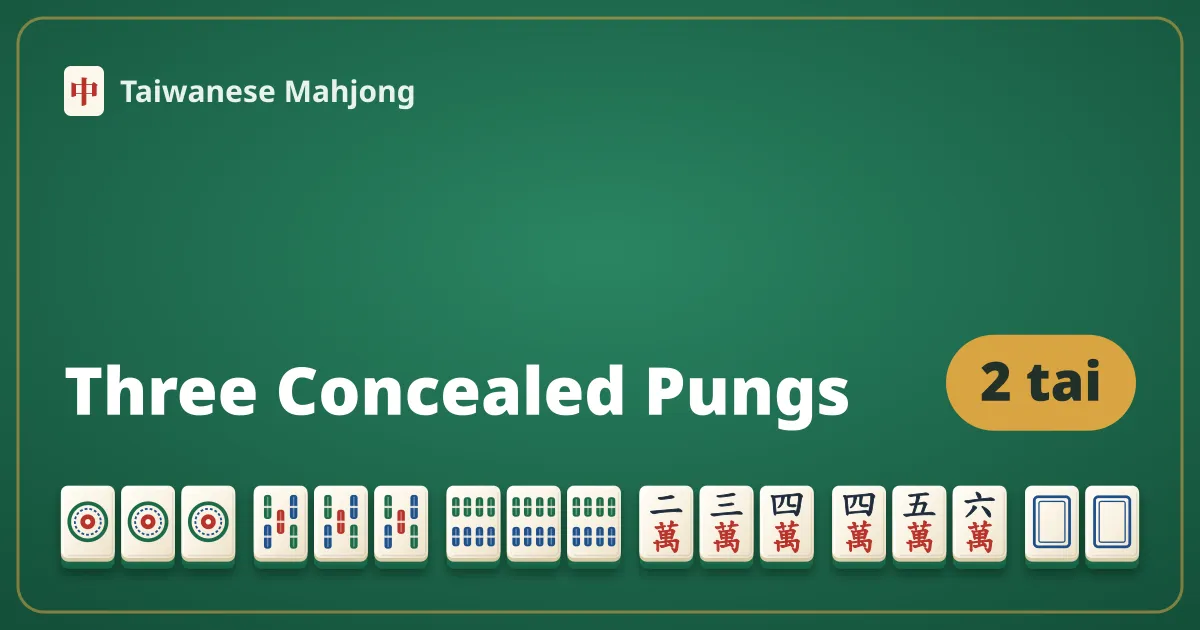 Three Concealed Pungs 2 tai
Three self-drawn pungs for 2 tai: which pungs count as concealed, when a discard costs you one, and how to upgrade to four.
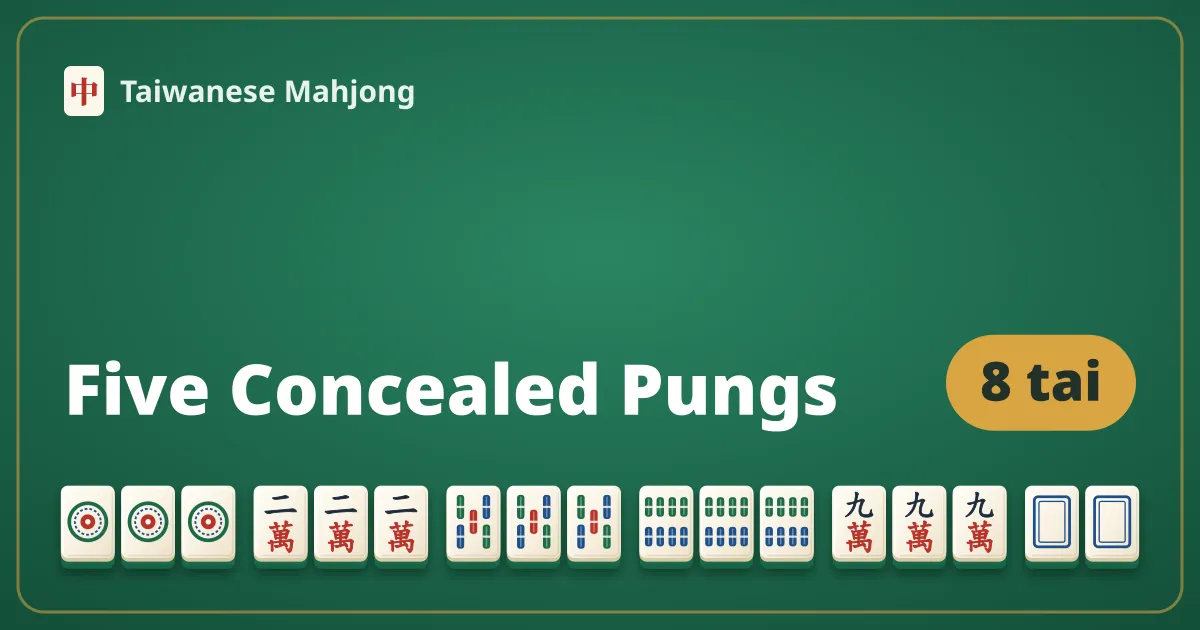 Five Concealed Pungs 8 tai
All five pungs self-drawn, an 8-tai big hand: always All Pungs too, and a single wait on a discard still counts.
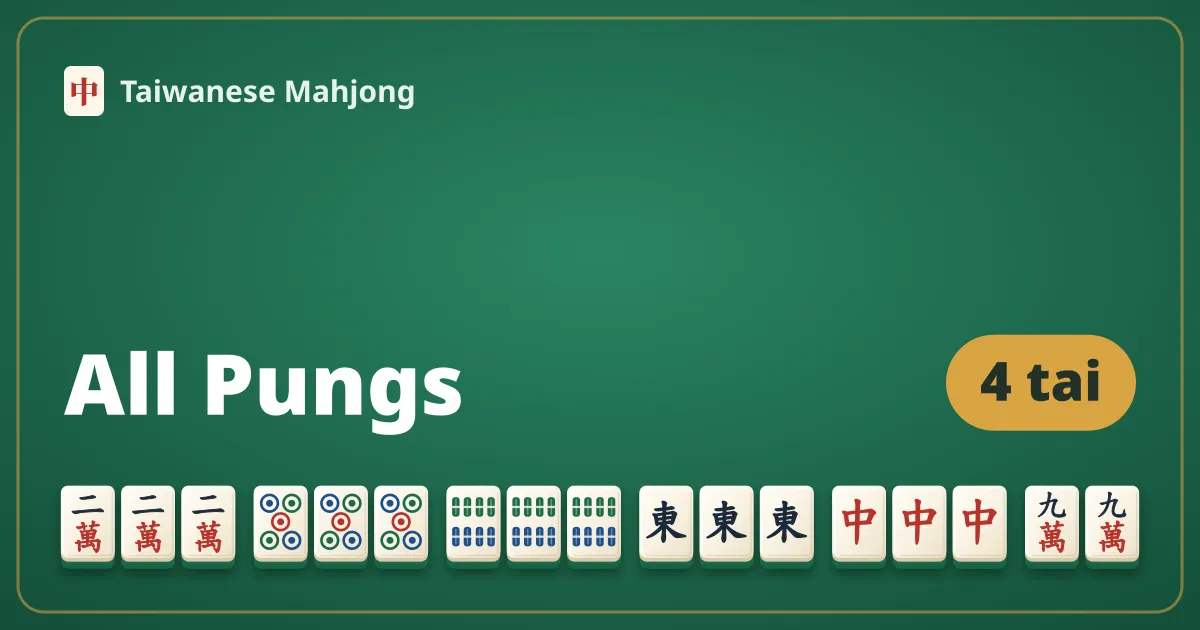 All Pungs 4 tai
Five pungs and a pair, no chows allowed — 4 tai. Examples, scoring combos and how many pairs you need to go for it.
Try it at the table
Taiwanese Mahjong — Play authentic Taiwanese 16-tile mahjong free in your browser against three computer opponents. Flowers, chow, pung, kong, dealer streaks and automatic tai scoring. No sign-up, works on phone and desktop.