Taiwanese Mahjong · 8 tai
Five Concealed Pungs (Wu An Ke) in Taiwanese Mahjong: Tai, Examples and Odds
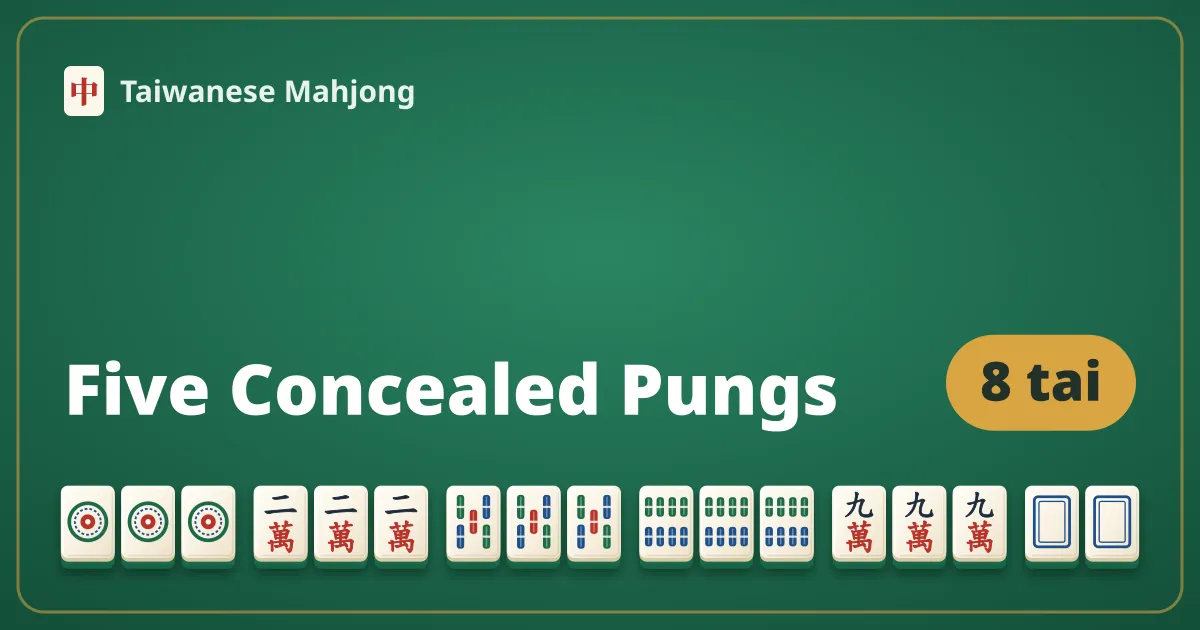
In Taiwanese mahjong, Five Concealed Pungs (五暗刻, wu an ke) is worth 8 tai: when you win, all five sets are pungs and every one was drawn yourself (concealed pungs or concealed kongs) — nothing claimed at all. Five pungs means it is always All Pungs as well.
On this page
The rules for Five Concealed Pungs
- All five sets are pungs or concealed kongs, all drawn yourself
- No pungs, no exposed or added kongs — and no chows (a chow is a run)
- A pung completed by someone's discard is not concealed: on a discard win, only a wait on the pair can still be Five Concealed Pungs
- Always also All Pungs for 4 tai; when self-drawn, always concealed self-draw for 3 tai
- Only the highest of the concealed-pung family counts: no extra Four or Three Concealed Pungs
How Five Concealed Pungs waits
Two-pair wait: only a self-draw makes five
Four concealed pungs plus two pairs, waiting for either. A self-drawn fifth pung is concealed, so it's Five Concealed Pungs; a pung made from someone's discard is exposed, leaving four.
Single wait: a discard is fine
All five concealed pungs are done and one tile waits for its pair. The winning tile makes the pair, not a pung, so a discard win is still Five Concealed Pungs; waiting on just that tile also scores single wait.
How Five Concealed Pungs is scored
The tai below are computed live by the same scoring code the game uses (dealer and dealer-streak tai are added on top).
Self-drawn
| Concealed self-draw (不求人) | 3 |
| All pungs (碰碰胡) | 4 |
| Five concealed pungs (五暗刻) | 8 |
| Total | 15 tai |
|---|
Dealer and dealer-streak tai are added on top.
Self-drawn
| Concealed self-draw (不求人) | 3 |
| Single wait (獨聽) | 1 |
| All pungs (碰碰胡) | 4 |
| Five concealed pungs (五暗刻) | 8 |
| Total | 16 tai |
|---|
Dealer and dealer-streak tai are added on top.
Won on a discard
| Concealed hand (門清) | 1 |
| Single wait (獨聽) | 1 |
| All pungs (碰碰胡) | 4 |
| Five concealed pungs (五暗刻) | 8 |
| Total | 14 tai |
|---|
Dealer and dealer-streak tai are added on top.
Common combinations:
| Combination | Tai |
|---|---|
| Five Concealed Pungs + All Pungs + concealed hand (discard win) | 13 |
| Five Concealed Pungs + All Pungs + concealed self-draw | 15 |
| Plus Half One Suit | 19 |
| Plus Pure One Suit | 23 |
How it relates to other hands
- All Pungs: Five Concealed Pungs is always All Pungs; both score.
- Concealed self-draw: nothing claimed means a concealed hand; a self-draw adds concealed self-draw.
- Four Concealed Pungs: one short. The usual way to drop to four is a two-pair wait won on a discard.
- Half One Suit, Pure One Suit, dragon and wind pungs: suits and honors score as usual, so it can stack very high.
- Heavenly and Earthly hands: five pungs on the deal are Five Concealed Pungs too; Heavenly and Earthly replace concealed self-draw, but Five Concealed Pungs and All Pungs still count.
Five Concealed Pungs odds
You have to draw all five pungs yourself. A 16-tile opening hand has 3 or more pungs only 0.0086% of the time, and 5 or more pairs about 2.1%.
| 16-tile opening hand | Chance |
|---|---|
| 2+ pungs | 0.78% |
| 3+ pungs | 0.0086% |
| 5+ pairs | 2.1% |
| 6+ pairs | 0.15% |
Four computers playing normally for 12,000 hands produced 11,677 wins, and Five Concealed Pungs appeared 0 times. A hand this rare is too scarce in our simulation to estimate a reliable rate; all we can say is that opening hands seldom hold ready pungs, and drawing all five yourself is a matter of luck more than planning.
How to play for Five Concealed Pungs
- Five or more pairs, and nobody has punged your tiles: consider not punging anything and waiting to draw.
- One pung and it's gone: Five Concealed Pungs allows no claims at all; but after one pung you can still go for Four Concealed Pungs + All Pungs.
- Prefer a single wait: a two-pair wait won on a discard drops to four; a single wait on a discard is still five — and you can pick an honor or edge tile others are likely to discard.
- When to give up: less than half the wall left and fewer than three concealed pungs — pung your pairs and play All Pungs or a normal hand.
To practise, open a table of online Taiwanese mahjong — the computers play with you and count the tai for you.
Five Concealed Pungs in other mahjong styles
Five Concealed Pungs only exists in 16-tile Taiwanese mahjong: 13-tile styles have just four sets, so four concealed pungs is the maximum.
- Japanese mahjong: "Suuankou" (four concealed pungs) is a yakuman (Japanese mahjong yaku list)
- Hong Kong mahjong: Four Concealed Pungs is a limit hand (Hong Kong mahjong fan list)
- Chinese Official (Guobiao): Four Concealed Pungs is 64 fan (Guobiao fan list)
FAQ
How many tai is Five Concealed Pungs?
In Taiwanese mahjong Five Concealed Pungs is worth 8 tai, always plus All Pungs for 4 tai; self-drawn it adds concealed self-draw for 3 tai, 15 tai in total.
Can a win on a discard be Five Concealed Pungs?
Yes, but only when the winning tile makes the pair. Then all five pungs are still self-drawn; on a two-pair wait, the pung completed by the discard is exposed and only four remain.
Does a concealed kong count as one of the five?
Yes. A concealed kong is four tiles you drew yourself and counts as a concealed pung; exposed and added kongs don't.
Do Five and Four Concealed Pungs both score?
No. They're one family, so only the highest — Five Concealed Pungs — counts.
Related hands
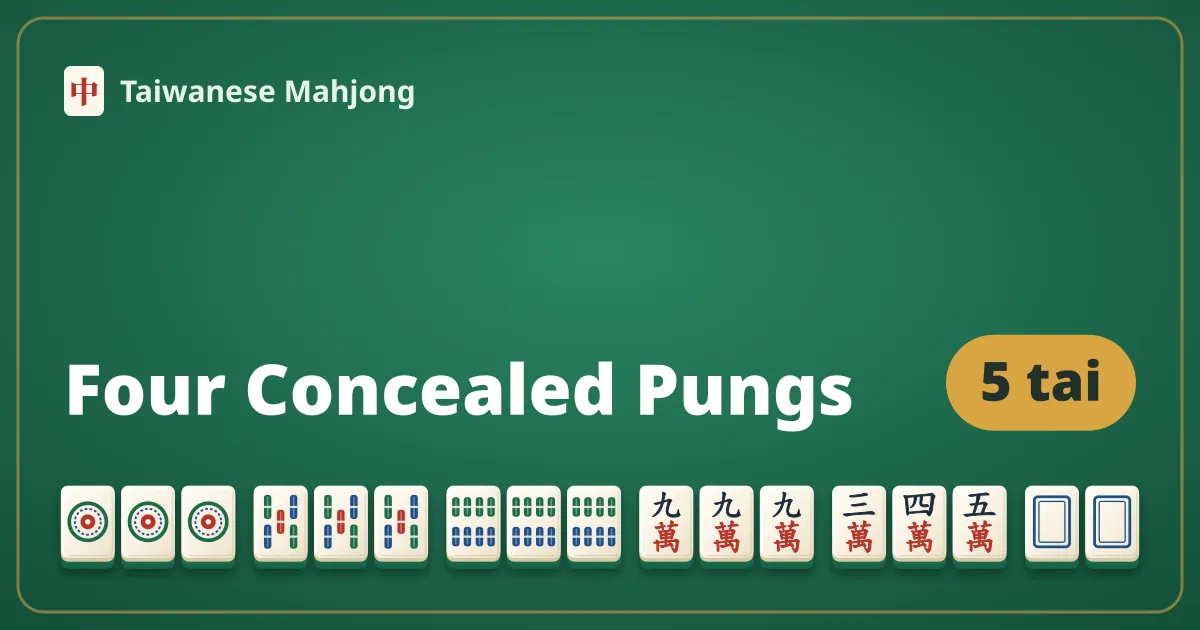 Four Concealed Pungs 5 tai
Four self-drawn pungs for 5 tai: a pung completed on a discard doesn't count, and one more makes five.
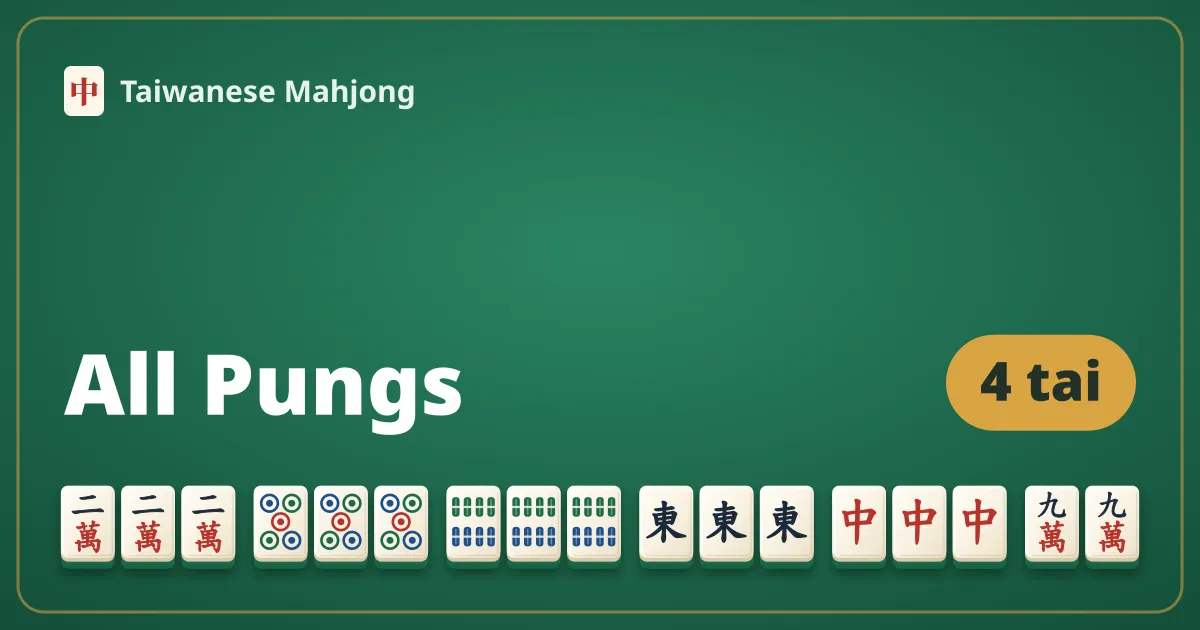 All Pungs 4 tai
Five pungs and a pair, no chows allowed — 4 tai. Examples, scoring combos and how many pairs you need to go for it.
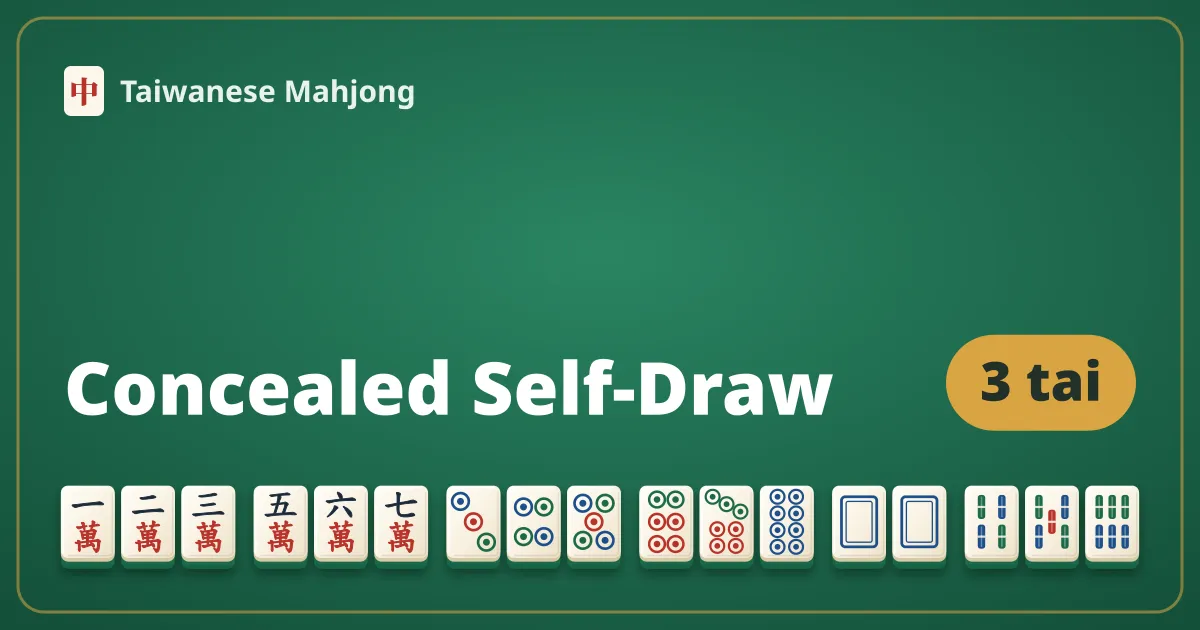 Concealed Self-Draw 3 tai
Never claim a tile and self-draw the win — 3 tai. Concealed hand vs self-draw, concealed kongs and replacement wins, and how often it happens.
Try it at the table
Taiwanese Mahjong — Play authentic Taiwanese 16-tile mahjong free in your browser against three computer opponents. Flowers, chow, pung, kong, dealer streaks and automatic tai scoring. No sign-up, works on phone and desktop.